Counterfeit Rabies Vaccine Alert: Australia Warns of Fake Abhayrab Doses Circulating in India Since 2023
Understanding Rabies: The Disease Context
Rabies Disease Overview and Transmission
Rabies is a fatal viral disease that attacks the central nervous system and is almost invariably fatal once clinical symptoms develop. The disease is transmitted to humans primarily through bites or scratches from infected animals, most commonly domestic dogs, but also wild animals including monkeys, bats, and raccoons. Once the rabies virus enters the body through breaks in the skin or mucous membranes, it travels along nerve pathways toward the brain, where it replicates and eventually causes neurological disease manifesting as behavioral changes, hydrophobia (fear of water), paralysis, and death.[1]
Global and Indian Rabies Burden
According to the World Health Organization, rabies causes approximately 59,000 deaths annually worldwide, with Asia and Africa accounting for over 95% of deaths. India bears an exceptionally high disease burden, with an estimated 18,000-20,000 rabies deaths annually—accounting for one-third of global rabies mortality despite comprising only 17% of world population. This disproportionate burden reflects the high prevalence of free-roaming, unvaccinated dog populations combined with limited access to post-exposure prophylaxis (PEP) in many regions.[1]
Why Effective Rabies Vaccination Is Critical
Once rabies symptoms develop, the disease is almost universally fatal—only a handful of survivors exist despite intensive medical intervention. Therefore, post-exposure rabies vaccination immediately following potential exposure represents the only effective intervention preventing disease development, making rabies vaccine effectiveness literally a matter of life and death. For individuals vaccinated prophylactically (before exposure), authentic rabies vaccination provides protection enabling simplified post-exposure treatment if exposure subsequently occurs.[1]

Neuroimmunology of rabies: New insights into an ancient ...
The Counterfeit Alert: Timeline and Discovery
When Counterfeits Were First Identified
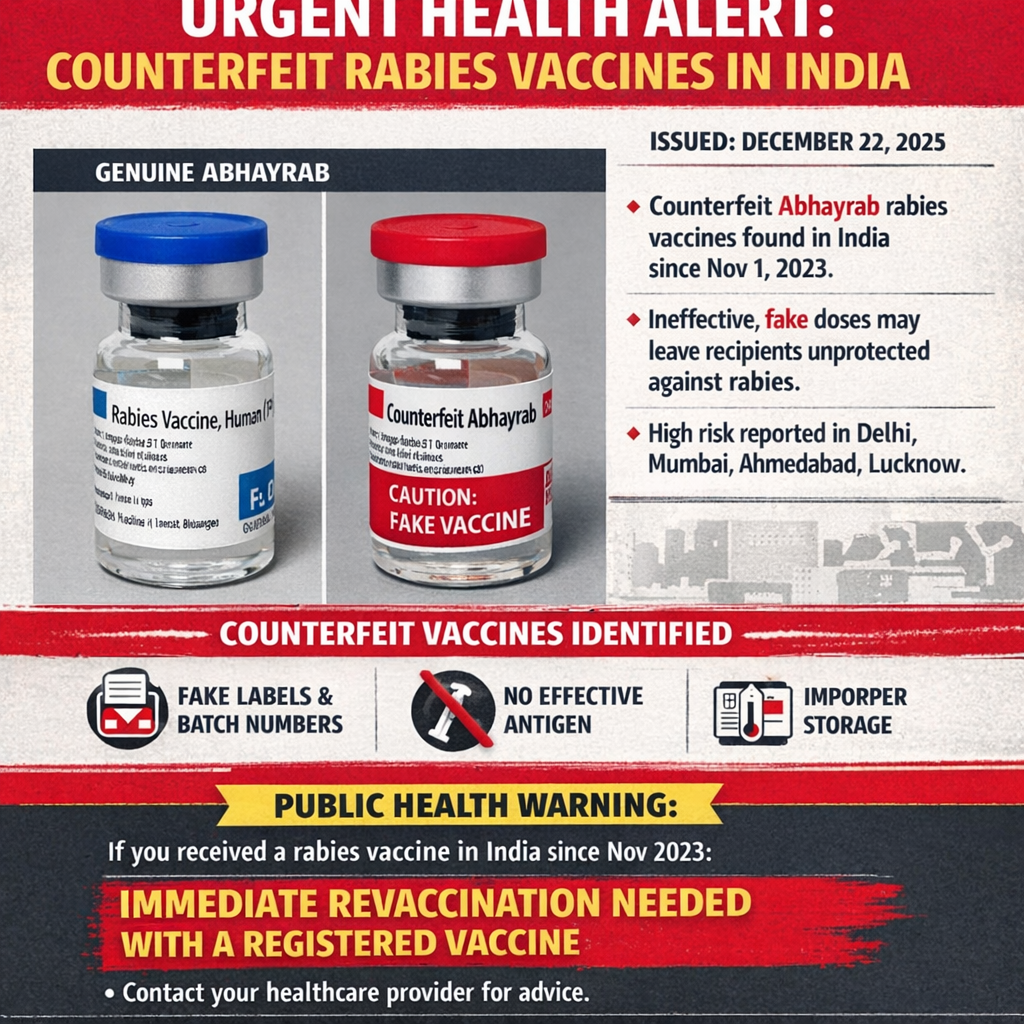
Indian Immunologicals Limited, the manufacturer of Abhayrab rabies vaccine, first identified counterfeit products in early 2025 during market surveillance activities. Investigation revealed that counterfeiters had successfully copied genuine batch numbers, packaging, labeling, and product presentation with remarkable precision, creating fake products nearly indistinguishable from authentic vaccines.[1]
Geographic Distribution and Extent
Counterfeit Abhayrab doses have been identified in several major Indian cities including Delhi, Mumbai, Ahmedabad, and Lucknow, indicating wide geographic distribution. However, Australian health authorities cautioned that the full extent of counterfeit distribution throughout India remains unclear, and additional contaminated batches may exist beyond currently identified locations. This uncertainty requires broad precautions for anyone vaccinated in India during the affected period.[1]
The alert specifies that individuals who received Abhayrab vaccination in India from November 1, 2023 onwards may have been administered counterfeit doses. This extended time period—nearly 14 months from alert date (December 22, 2025) back to November 2023—suggests the counterfeit operation operated undetected for extended period, potentially affecting hundreds of thousands of individuals.[1]

Nobivac® 3-Rabies, 10 dose vial
How Counterfeits Enter the Supply Chain: Manufacturing and Deception
The Counterfeit Operation's Sophistication
The counterfeiters demonstrated remarkable sophistication in replicating authentic Abhayrab products, copying not only the active vaccine ingredients but also batch numbers, packaging design, labeling, and all visual elements that might distinguish authentic from counterfeit vials. This level of detail suggests organized criminal activity with access to detailed product specifications and manufacturing expertise.[1]
Specific batch number KA24014 was identified as copied by counterfeiters, demonstrating that even unique batch identifiers—typically used to track authenticity—were successfully replicated. This capability suggests counterfeiters possessed access to detailed information about genuine product batches.[1]
Differences Detected by Investigators
While counterfeits visually resembled authentic vaccines closely, investigators identified substantive differences in:[1]
· Chemical composition: The active rabies antigen content differed from authentic vaccines
· Packaging design: Upon careful examination, packaging materials and design details differed from genuine products
· Labeling quality: Text clarity, color printing, and labeling accuracy showed discrepancies
However, these differences were subtle enough that distinguishing counterfeit from authentic vaccines would prove extremely difficult for healthcare providers, patients, or even distributors without detailed comparison or laboratory testing.[1]
How Counterfeits Entered the Market
The precise mechanism through which counterfeit vaccines entered the Indian market has not been fully disclosed, but typically, counterfeit pharmaceuticals enter supply chains through multiple routes including:[1]
· Diversion of authentic products from authorized distributors through parallel markets
· Infiltration of wholesale pharmaceutical distribution channels with counterfeit products
· Falsification of import/export documentation enabling counterfeits to pose as legitimate products
· Corruption of supply chain intermediaries accepting bribes to distribute counterfeit products

The impact of counterfeit drugs in south and south-east Asia
Why Counterfeit Vaccines Are Ineffective and Dangerous
Mechanism of Vaccine Ineffectiveness
Counterfeit rabies vaccines may fail to provide immunity through multiple mechanisms:[1]
1. Insufficient Active Antigen: The active rabies virus antigen—the component stimulating protective immune response—may be absent, underdosed, or degraded in counterfeit vaccines, resulting in failure to generate antibodies and immune memory needed for protection.[1]
2. Improper Storage: Rabies vaccines require strict temperature control (typically 2-8°C refrigeration).** Counterfeit products may have been stored outside required temperature ranges, causing antigenic degradation and loss of immunogenicity while remaining visually unchanged.[1]
3. Contamination: Counterfeit manufacturing may involve contamination with substances damaging the vaccine's biological activity or causing adverse effects.[1]
4. Incorrect Formulation: Counterfeiters may use incorrect manufacturing processes, ingredients, or concentrations, resulting in products lacking proper immunogenicity.[1]
Consequences of Counterfeit Vaccination
Individuals receiving counterfeit rabies vaccines face two catastrophic consequences:[1]
1. False Sense of Security: Recipients believe they are protected against rabies when they are actually completely unprotected.** If exposed to the rabies virus, they have no immune protection and will almost certainly develop rabies disease.[1]
2. Potential for Post-Exposure Prophylaxis Failure: Individuals vaccinated with counterfeit vaccines before exposure, who subsequently receive counterfeit boosters as post-exposure prophylaxis (PEP), may fail to develop protective immunity despite following correct PEP protocols.** Standard PEP protocols assume authentic vaccines; counterfeit vaccines may not provide protection regardless of vaccination schedule.[1]

Dog Bite to the Hand: Infectious Disease Considerations | Cureus
Public Health Response and Affected Populations
The Australian Advisory Group Response
The Australian Technical Advisory Group on Immunisation, coordinating with state health departments, issued urgent guidance recommending that anyone vaccinated with rabies vaccine in India during the affected period should be considered potentially exposed to counterfeit doses and require revaccination with authentic, registered vaccines.[1]
Significantly, Australian authorities stated that because visual distinction between authentic and counterfeit Abhayrab vials is extremely difficult, all Abhayrab doses administered in India from November 1, 2023 onwards should be treated as potentially invalid, regardless of whether specific recipients received batches later identified as counterfeit. This precautionary approach maximizes public health protection.[1]
Vulnerable Populations Requiring Urgent Action
Multiple populations have been identified as potentially affected:[1]
Travelers Seeking Post-Exposure Prophylaxis: Foreign travelers who received rabies vaccination after dog or animal bites while visiting India
Travelers Receiving Preventive Vaccination: Foreign travelers who received rabies vaccination prophylactically before traveling to India or other rabies-endemic regions
Residents and Workers: Indian residents and occupational workers (veterinarians, animal handlers, dog catchers) who received rabies vaccination for occupational protection
Healthcare and Laboratory Workers: Healthcare professionals and laboratory personnel who received rabies vaccination due to occupational exposure risk

New Approaches to Evaluating Vaccine Quality Control & Safety
Recommendations for Affected Individuals
Australian health authorities have provided explicit recommendations for individuals potentially exposed to counterfeit rabies vaccines:[1]
1. Consult Healthcare Providers: Anyone who received rabies vaccination in India from November 1, 2023 onwards should consult healthcare professionals without delay to assess their situation and discuss revaccination.
2. Obtain Replacement Vaccination: Affected individuals should receive replacement doses using rabies vaccines registered and approved in their country (in Australia: Rabipur or Verorab).** These vaccines are manufactured under strict regulatory oversight and contain proven active antigens.[1]
3. Maintain Detailed Records: Individuals are advised to keep detailed vaccination records including photographs of vaccine vial packaging, batch numbers, and vaccination dates.** This documentation assists healthcare providers in determining whether specific vaccines received were among identified counterfeit batches.[1]
Post-Exposure Prophylaxis Protocols for Exposed Individuals
For individuals who received counterfeit rabies vaccines and subsequently experience potential rabies exposure (animal bite, scratch, or mucous membrane exposure to animal saliva), revised post-exposure prophylaxis protocols are critical:[1]
1. Immediate Wound Care: Thorough cleaning and disinfection of the wound with soap and water, followed by application of antiseptic solution (povidone-iodine or chlorhexidine)
2. Immediate Rabies Immunoglobulin (RIG) Administration: Rabies immunoglobulin should be administered as soon as possible following exposure, regardless of prior vaccination history
3. Complete Rabies Post-Exposure Vaccination Series: A complete course of rabies post-exposure prophylaxis using authentic, registered vaccines should be administered according to standard protocols (typically intramuscular or intradermal administration on days 0, 3, 7, 14, and 28)
This intensive post-exposure approach is necessary for individuals with questionable prior vaccination history to ensure maximum protection.[1]
Travel Recommendations and Prevention Strategies
For travelers planning to visit India or other rabies-endemic countries, Australian health authorities recommend:[1]
1. Pre-Exposure Rabies Vaccination: Complete pre-exposure rabies vaccination before travel using authenticated, registered vaccines in the traveler's home country.** This simplifies post-exposure management if exposure occurs during travel.[1]
2. Documentation: Maintain detailed records of all vaccinations received, including vaccine names, batch numbers, dates, and photographs of vial packaging.**[1]
3. Know Your Risk: Understand occupational and behavioral risk factors increasing rabies exposure (contact with stray dogs, monkeys, bats, or other mammals), and avoid these exposures whenever possible.
Travelers to India and other rabies-endemic countries should adopt protective behaviors including:[1]
· Avoid contact with stray dogs, monkeys, and other wild or domestic mammals
· Never attempt to feed or pet unfamiliar animals
· Maintain distance from animals showing aggressive or unusual behavior
· If bitten or scratched, immediately seek medical evaluation and post-exposure prophylaxis

Rabies - Sparsh Diagnostic Center
The Broader Context: International Scrutiny of Indian Pharmaceuticals
Recent History of Pharmaceutical Quality Issues
This alert comes amid heightened international scrutiny of medicines and vaccines manufactured in India, following reports in recent years of substandard or counterfeit pharmaceutical products causing deaths or serious illness internationally. These reports have raised questions about pharmaceutical manufacturing standards, quality control oversight, and regulatory enforcement in some Indian manufacturing facilities.[1]
Role of Manufacturing Standards and Regulatory Oversight
Indian Immunologicals Limited has emphasized that authentic Abhayrab manufactured by the company meets strict quality standards, with every batch tested and released by the Central Drugs Laboratory under the Government of India before approval for public distribution. The company notes that Abhayrab, manufactured since 2000, has supplied over 210 million doses in India and over 40 countries, accounting for approximately 40% of the domestic rabies vaccine market.[1]
The counterfeit alert reflects not a failure of the legitimate manufacturer but rather the challenge of preventing sophisticated counterfeiters from infiltrating pharmaceutical supply chains despite robust manufacturing quality standards. Counterfeit prevention requires cooperation among manufacturers, regulatory authorities, distributors, and international health agencies.[1]

How Vaccines are Developed and Approved for Use | Vaccines ...
Previous Similar Alerts: Learning From History
UK and US "Look-Back" Investigations
This is not the first international health alert related to rabies treatment received in India. Earlier in 2025, both the United Kingdom Health Security Agency and the United States Centers for Disease Control and Prevention conducted "look-back" investigations after a rabies death was associated with rabies treatment received during travel in India.[1]
These prior investigations, combined with the current Abhayrab counterfeit alert, demonstrate repeated instances of compromised rabies prevention products in India, warranting heightened vigilance by international health authorities.[1]
Public Health Implications and System Improvements Needed
Vulnerabilities in Pharmaceutical Supply Chains
This alert highlights critical vulnerabilities in pharmaceutical supply chains, particularly in regions where regulatory oversight, counterfeit detection capabilities, and supply chain integrity controls may be limited. Counterfeiters can successfully replicate even sophisticated product security features, requiring multi-layered approaches to verification.[1]
Need for International Cooperation
Effective counterfeit prevention requires international cooperation including:[1]
· Enhanced information sharing among national health authorities regarding counterfeit product identification
· Strengthened regulatory oversight of pharmaceutical manufacturing and distribution channels
· Development and deployment of advanced anti-counterfeiting technologies (holograms, microchips, blockchain-based tracking)
· Standardized international protocols for pharmaceutical product verification
· Rapid communication systems enabling quick dissemination of alerts when counterfeits are detected
Importance of Supply Chain Transparency
Pharmaceutical manufacturers and distributors should implement transparent, traceable supply chains enabling rapid identification and removal of counterfeit products when detected. Blockchain technology and similar innovations offer potential to create permanent, verifiable records of pharmaceutical product movement through supply chains, making counterfeit infiltration more difficult.[1]
Manufacturer Response and Quality Assurance Statements
Indian Immunologicals Limited Statement
In response to the counterfeit alert, Indian Immunologicals Limited has emphasized that authentic Abhayrab supplies remain safe and of standard quality. The company stated: "We would like to reiterate and provide confidence to healthcare professionals and the general public that all supplies made through our authorised distributors are safe and of standard quality."[1]
The manufacturer emphasized its commitment to quality, safety, and transparency in the public health interest, and noted that it is actively working with regulatory authorities and law enforcement agencies to investigate the counterfeit operation and support efforts to prevent future counterfeiting.[1]
Conclusion: Urgent Need for Vigilance and Revaccination
The Australian alert regarding counterfeit Abhayrab rabies vaccine doses circulating in India since November 2023 represents a serious public health emergency affecting potentially hundreds of thousands of individuals who believe they are protected against rabies but may be completely unprotected. Counterfeit vaccines, designed with sophistication that makes them nearly indistinguishable from authentic products, may contain no active antigen or degraded antigen, leaving recipients vulnerable to what is almost invariably a fatal disease.[1]
Anyone vaccinated with rabies vaccine in India during the affected period should immediately consult healthcare providers and arrange revaccination with authenticated, registered vaccines to ensure genuine protection. For travelers to India or other rabies-endemic countries, pre-travel vaccination in the home country using authentic vaccines, combined with meticulous documentation and avoidance of animal contact, provides optimal protection.[1]
This alert underscores the critical importance of robust pharmaceutical supply chain oversight, international cooperation in detecting and preventing counterfeit products, and rapid communication systems enabling quick public health response when counterfeits are identified. The tragic consequences of counterfeit life-saving vaccines—potential rabies infection and near-certain death—demand the highest standards of pharmaceutical manufacturing, quality control, and counterfeiting prevention.[1]
For the millions at risk from rabies globally, and particularly in endemic regions like India, ensuring access to authentic, effective vaccines represents an essential public health priority. Vigilance, rapid response to counterfeit detection, and proactive revaccination of potentially affected individuals are critical to preventing the tragedy of vaccine-preventable disease occurring in vaccinated individuals.[1]
Citations:
Australian Technical Advisory Group on Immunisation - Rabies Vaccine Alert (December 22, 2025); Indian News Network - Rabies Vaccine Alert: Australia Warns of Counterfeit Doses in India (2025); Indian Immunologicals Limited - Statement on Abhayrab Counterfeit Products (2025); World Health Organization - Rabies Disease Information and Global Burden; Cureus - Dog Bite to the Hand: Infectious Disease Considerations; Sparsh Diagnostic Center - Rabies Transmission and Prevention; StoryMD - Signs and Symptoms of Rabies; How Vaccines are Developed and Approved for Use - Vaccine Safety Information; Gavi - Boost Access to Life-Saving Human Rabies Vaccines; Maxim Biomedical - Rabies Virus Information; UK Health Security Agency - Rabies Investigation Following Travel to India; US Centers for Disease Control and Prevention - Rabies Post-Exposure Prophylaxis Guidelines; Health experts - Supply Chain Integrity and Counterfeit Prevention in Pharmaceuticals[1]

Post your opinion
No comments yet.