Bombay High Court Orders Immediate Takedown of Deepfake and Morphed Content Misusing Shilpa Shetty's Image
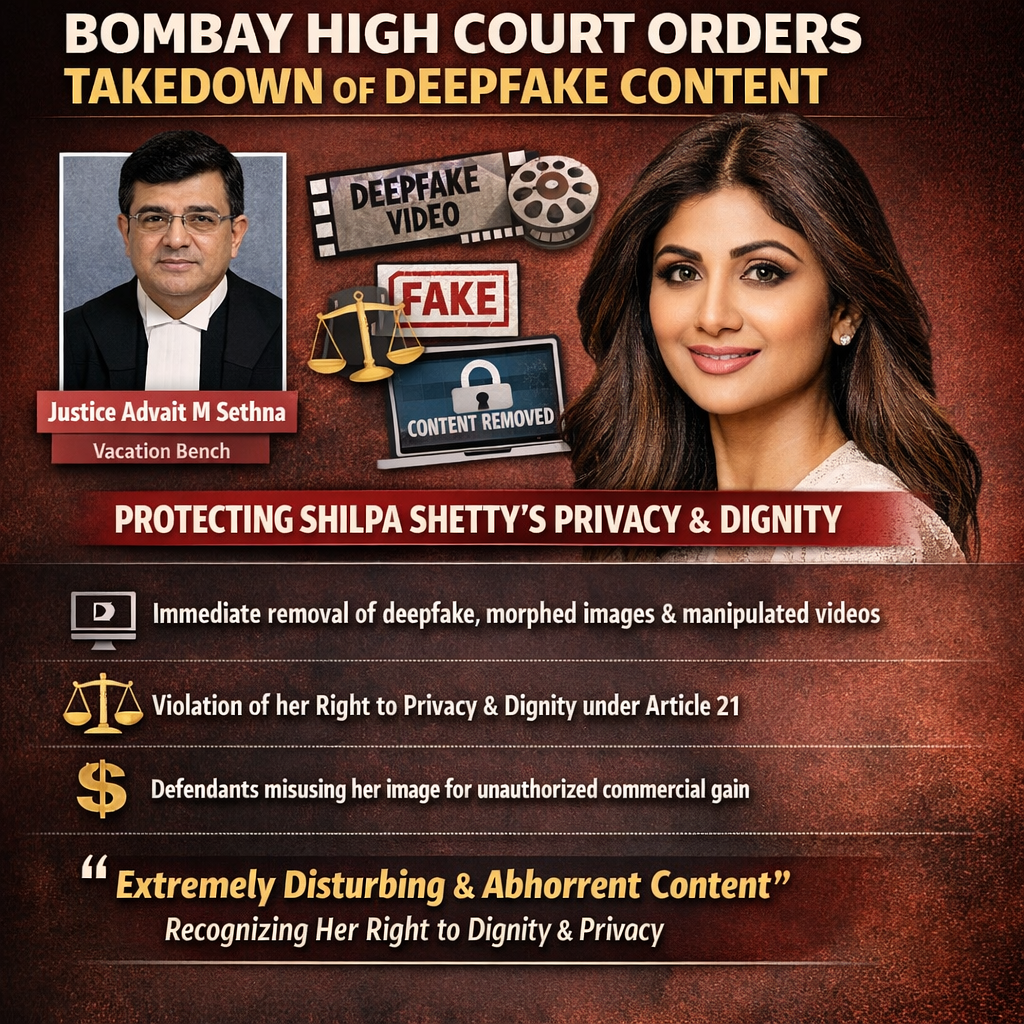
The Court Order: Interim Relief and Immediate Takedown Directive
Vacation Bench Composition and Judicial Authority
The interim relief order was issued by a vacation Bench comprising Justice Advait M Sethna of the Bombay High Court during weekend hearings when regular court proceedings are suspended. The vacation Bench operates with constitutional authority to address urgent matters requiring immediate judicial intervention, demonstrating the court's recognition of deepfake content misuse as sufficiently emergent to warrant extraordinary judicial procedure.
Vacation Benches traditionally handle urgent matters like habeas corpus petitions, interim injunctions, and emergent relief requiring judicial determination outside normal court schedules. Shilpa Shetty's deepfake case's assignment to vacation Bench indicates judicial assessment that the content misuse constituted sufficiently pressing violation warranting extraordinary procedure.
Comprehensive Takedown Directive: Target Entities and Content Categories
Justice Sethna directed multiple categories of defendants to execute immediate content removal:
Social Media Platforms:
· Instagram, Facebook, Twitter/X, YouTube, and other major platforms required to remove or disable access to offensive content
AI-Linked Defendants:
· Companies developing or utilizing artificial intelligence tools for content generation and deepfake creation
John Doe Defendants:
· Unknown or unidentified entities operating in digital space
Required Removal Actions:
· Delete or disable access to URLs containing manipulated content
· Remove links directing to problematic material
· Delete social media posts containing morphed images or manipulated videos
· Disable access to websites hosting the unauthorized content
· Remove merchandise listings and commercial products featuring misused likeness
The comprehensive scope—encompassing multiple platforms, various content formats, and diverse defendant categories—reflects judicial recognition that deepfake exploitation occurs across distributed digital infrastructure requiring coordinated takedown efforts.
Constitutional Basis: Article 21 Right to Privacy and Dignity
Justice Sethna emphasized the constitutional foundation for the interim relief, anchoring the order in Article 21 of the Indian Constitution—the fundamental right to life and personal liberty, including inherent privacy and dignity protections. The judge remarked: "No personality, much less a person and or a woman, can be portrayed in a fashion which affects her fundamental right to privacy and that too, without her knowledge and or consent."
This constitutional framing—rather than relying exclusively on intellectual property statutes—establishes privacy and dignity as independent legal grounds for deepfake content prohibition, transcending purely commercial concerns regarding personality exploitation. The constitutional approach acknowledges that deepfake misuse violates fundamental human rights regardless of whether personality rights achieve full statutory recognition.
The judge further observed that "No personality should be portrayed in a manner affecting their fundamental right to privacy," establishing categorical judicial statement regarding deepfake content impermissibility that potentially extends beyond Shilpa Shetty's specific case to establish broader precedent.

Bombay High Court is one of the oldest High Courts of India ...

All you need to know about personality rights in India ...

The Plaintiff's Case: Personality Rights Violation and AI Exploitation
Shilpa Shetty's Allegations: Comprehensive Digital Misuse
In her plaint filed with the court, Shilpa Shetty Kundra alleged that AI tools are being systematically exploited to:
Voice and Mannerism Cloning:
· AI technology cloning her distinctive voice patterns and linguistic mannerisms
· Automated replication of her characteristic speaking style and vocal qualities
Morphed Image Generation:
· Creation of digitally manipulated images depicting her in compromising, inappropriate, or non-consensual scenarios
· Fabrication of fake photographs inconsistent with her actual appearance or activities
Unauthorized Merchandise Creation:
· Generation of fake posters featuring her image
· Creation of fictional "diaries" falsely attributed to her
· Unauthorized "books" claiming her authorship
· Merchandise products utilizing her likeness without consent
Monetization Without Authorization:
· Commercial exploitation of generated content through paid platforms
· Revenue generation from unauthorized use of her persona
· Merchandise sales using her image and likeness
Exposure to Ridicule and Humiliation:
· Placement in scenarios designed to create "unsavoury humour"
· Deliberate creation of content intended to ridicule or embarrass
· Harmful narrative construction around fabricated scenarios
This comprehensive allegation pattern demonstrates deepfake technology's devastating potential to simultaneously violate privacy, damage reputation, enable commercial exploitation, and facilitate psychological harm.
Celebrity Status and Social Media Presence: Vulnerability to Exploitation
The court acknowledged that Shilpa Shetty is "a reputed film and TV personality with over 3.33 crore Instagram followers," establishing her substantial public presence and cultural prominence. The court recognized that her extensive social media following creates both significant vulnerability to deepfake misuse (larger audience exposure amplifies harm) and responsibility to protect her image.
The judge noted that such extensive public reach means that material depicting her inappropriately "is likely to tarnish her image and reputation," indicating that deepfake content's viral potential creates exponentially greater damage than obscure misuse. The large follower base transforms even limited deepfake content into potential reputational catastrophe.
Unauthorized Commercial Endorsements: Personality Rights Dimension
Shilpa Shetty's counsel, advocate Sana Raees Khan, argued during proceedings that defendants were "misusing the actor's photographs and persona for selling sarees and other products without authorisation." This commercial exploitation dimension—using her likeness for product sales without compensation or consent—represents classic personality rights violation transcending purely privacy concerns.
The allegation that her image is being exploited for commercial merchandise (specifically mentioned: sarees) establishes that deepfake misuse extends beyond creating embarrassing content to systematic commercial exploitation where bad actors profit from her celebrity status and likeness. The saree example suggests fashion and apparel industry particularly vulnerable to unauthorized celebrity endorsement exploitation.

Introduction To Intellectual Property Rights in India | Legodesk

Deepfake Detection with AI
Legal Framework: Personality Rights, Copyright, and Constitutional Protections
Personality Rights and Publicity Rights: Evolving Legal Landscape
Shilpa Shetty's suit raises complex questions regarding the extent to which Indian law recognizes and protects "personality rights" and "publicity rights"—legal concepts enabling celebrities to control commercial exploitation of their image, voice, name, and distinctive characteristics. While most legal systems recognize these rights to varying degrees, Indian law's precise treatment remains evolving and contested.
Personality rights encompass the legal authority to control how one's distinctive identity elements are presented, commercially exploited, and protected against unauthorized appropriation. Such rights traditionally include: name protection, image/likeness protection, voice protection, and protection of distinctive mannerisms or characteristics.
Publicity rights specifically address commercial exploitation dimension—the celebrity's right to benefit financially from commercial endorsements and merchandise featuring their likeness while preventing competitors from unauthorized use. The distinction between personality rights (controlling portrayal) and publicity rights (controlling commercial exploitation) remains legally significant.
Copyright Act Applicability Questions: Unresolved Legal Issues
Advocate Sana Raees Khan argued during proceedings that the defendants' conduct violated the Copyright Act in addition to personality and privacy rights. However, Justice Sethna cautioned that "the larger questions of personality and publicity rights asserted by Shetty under intellectual property laws would be decided by a regular Bench."
The judge explicitly noted that "the judge...repeatedly stressed that the issue of whether, and to what extent, personality rights are recognised and enforceable under the Copyright Act and other statutes would remain open and could not be conclusively adjudicated in a vacation sitting." This legal uncertainty—regarding whether existing copyright statutes adequately protect personality rights or whether additional legislative protection is necessary—remains open for broader judicial determination.
The copyright question reflects broader legal reality: copyright law traditionally protects creative works' ownership rather than personality exploitation prevention, creating potential gap where deepfake content might technically avoid copyright violation while constituting personality rights infringement.
Constitutional Privacy Rights: Article 21 Foundation
Rather than resting exclusively on uncertain personality rights statutory framework, Justice Sethna anchored the interim relief in Article 21 of the Indian Constitution—the fundamental right to life and personal liberty. This constitutional approach circumvents uncertainty regarding statutory personality rights by invoking basic human rights to privacy and dignity.
The Supreme Court has previously recognized that Article 21 incorporates right to privacy as fundamental constitutional protection, establishing constitutional basis for preventing unauthorized image manipulation and deepfake content creation. This constitutional foundation operates independently from intellectual property statutes, providing immediate protective recourse.
The constitutional approach acknowledges that deepfake misuse violates fundamental human dignity regardless of commercial exploitation or intellectual property considerations—the privacy violation itself constitutes constitutional harm meriting judicial intervention.

Understanding Deepfake Detection: Addressing Challenges and ...
Celebrity Deepfake Litigation Wave: Broader Industry Pattern
Growing Legal Response to AI-Generated Content Abuse
Shilpa Shetty's case reflects "a growing wave of litigation by Indian celebrities seeking to protect their personality and publicity rights against AI‑driven deepfakes, manipulated content and unauthorised commercial endorsements." Rather than isolated incident, her suit represents systematic pattern of celebrity deepfake misuse catalyzing legal response.
The litigation wave indicates several industry trends:
Deepfake Technology Proliferation:
· Increasing accessibility of deepfake creation tools enabling non-professionals to generate convincing fakes
· Declining technical barriers to sophisticated image and video manipulation
Commercial Monetization of Deepfakes:
· Bad actors establishing profitable businesses exploiting celebrity likenesses
· Revenue generation through unauthorized merchandise and content monetization
· Systematic commercial infrastructure built around stolen celebrity personas
Platform Inadequacy:
· Social media platforms' insufficient content moderation preventing deepfake proliferation
· Algorithmic amplification enabling rapid deepfake viral spread
· Platform policies lacking specific deepfake-content provisions
Celebrity Vulnerability:
· Particularly women celebrities experiencing disproportionate deepfake targeting
· Sexual or embarrassing deepfake content creating reputational and psychological harm
· International deepfake trend affecting Indian celebrities similarly to global pattern
Judicial Response and Legal Evolution
The Bombay High Court's interim relief order represents judiciary's recognition that existing legal frameworks require supplementation through constitutional rights interpretation and creative procedural orders. Rather than awaiting legislative solution, courts are using existing law—particularly Article 21 constitutional protections—to address deepfake emergency.
This judicial response pattern—recognizing legal gap and exercising judicial authority to protect fundamental rights—indicates courts' assessment that deepfake harm's urgency demands immediate action rather than waiting for legislative amendments.
Judicial Approach: Balancing Immediate Relief and Broader Legal Questions
Interim Relief Despite Unresolved Broader Questions
Justice Sethna employed sophisticated judicial strategy: granting immediate interim relief (content takedown) while explicitly reserving broader legal questions for regular Bench determination. This approach enables urgent protection without requiring conclusive resolution of complex personality rights legal issues.
The judge remarked that he "would, for the present, proceed on the basis that Shetty is a credible actress and that material misusing her image without consent cannot be broadcast," establishing pragmatic standard for interim relief: if plausible allegation that material misuses someone's image without consent, preliminary protection is warranted.
This interim approach avoids requiring Shilpa Shetty to definitively prove personality rights statutory recognition before obtaining emergency relief, instead anchoring preliminary protection in privacy rights while broader questions remain litigated.
Direction for Regular Bench: Broader Personality Rights Adjudication
Justice Sethna directed Shetty's counsel to "place proper statutory backing and precedents before the regular Bench to support the claim that the actor's personality rights had been infringed." This directive acknowledges that ultimate legal determination requires comprehensive briefing on personality rights doctrine, precedent analysis, and statutory interpretation.
The regular Bench will ultimately address:
Statutory Recognition Questions:
· Whether Indian Copyright Act recognizes personality rights protection
· Whether additional personality rights statutes exist or should be enacted
· How courts should interpret existing statutes to address deepfake misuse
Precedent Analysis:
· International precedent regarding personality rights protection
· Previous Indian court decisions addressing personality rights claims
· Comparative analysis of jurisdictions with established personality rights frameworks
Doctrinal Development:
· Appropriate scope of personality rights protection
· Balance between celebrity protection and public interest
· Distinction between legitimate commentary/parody and unauthorized commercial exploitation
Constitutional and Human Rights Implications
Privacy Rights Beyond Commercial Concerns
Justice Sethna's emphasis on Article 21 constitutional privacy rights reflects broader judicial recognition that deepfake harm extends beyond economic interests to fundamental human dignity and autonomy. Even if no commercial exploitation occurred, unauthorized image manipulation constitutes privacy violation meriting protection.
The judge's observation that "No personality, much less a person and or a woman, can be portrayed in a fashion which affects her fundamental right to privacy" extends protection beyond celebrity commercialism to universal human dignity—the principle that individuals retain fundamental autonomy over their bodily image and how they are represented to others.
Gender Dimensions: Disproportionate Deepfake Targeting
The judge's specific reference to protecting "a woman" alongside general personality protection suggests judicial recognition that deepfake misuse disproportionately targets women celebrities through sexual content, embarrassing scenarios, and harassment-oriented creation. The gender-specific language acknowledges that deepfake harm intersects with gender-based violence and sexual harassment patterns.
The constitutional right to dignity—particularly critical for women facing disproportionate deepfake targeting through non-consensual intimate imagery—operates as essential protection against systematic harassment and reputation destruction.
Conclusion: Interim Relief as Urgent Deepfake Protection
The Bombay High Court's interim relief order directing immediate takedown of deepfake and morphed content misusing Shilpa Shetty's image represents significant judicial response to AI-generated content abuse, recognizing deepfake creation and distribution as violation of fundamental constitutional privacy and dignity rights. Justice Advait M Sethna's order characterizes deepfake content as "prima facie extremely disturbing and abhorrent," establishing unequivocal judicial position that such content violates law and constitutional principles.
By anchoring the interim relief in Article 21 constitutional protections rather than uncertain statutory personality rights frameworks, Justice Sethna demonstrates creative judicial methodology enabling urgent relief despite unresolved broader legal questions. The approach balances immediate protection need against deference to regular Bench's role in definitively addressing statutory personality rights questions.
Shilpa Shetty's case reflects broader litigation pattern as Indian celebrities increasingly seek judicial protection against deepfake misuse, unauthorized merchandise exploitation, and AI-driven voice cloning. The case demonstrates judiciary's recognition that deepfake technology requires legal framework modernization and creative constitutional interpretation to provide adequate protection.
As the case progresses to regular Bench adjudication, Indian courts will likely develop more comprehensive personality rights doctrine and establish precedent influencing how deepfake misuse is addressed across entertainment industry and broader society. The interim relief establishes important judicial statement: deepfake creation and distribution constitutes illegal personality and privacy rights violation demanding immediate judicial intervention and platform accountability.**
Citations:
Bar and Bench - Bombay High Court orders immediate takedown of content misusing Shilpa Shetty image (2025); Bombay High Court judgment - Justice Advait M Sethna vacation Bench interim relief order; Indian Constitution - Article 21 fundamental rights provision on privacy and dignity; Copyright Act - Statutory intellectual property protection framework; Shilpa Shetty plaint - Original lawsuit allegations regarding deepfake misuse and personality rights violations; Advocate Sana Raees Khan arguments - Legal counsel statements during court proceedings; Bar and Bench legal analysis - Celebrity deepfake litigation wave and judicial response patterns; Constitutional law analysis - Article 21 privacy rights interpretation and deepfake protection; Personality rights doctrine - Legal framework for image, voice, and likeness protection; Social media platform responsibility - Content moderation obligations and deepfake prevention requirements

Post your opinion
No comments yet.