Waymo's San Francisco Robotaxi Outage Raises Critical Questions About Autonomous Vehicle Emergency Readiness and Regulatory Requirements
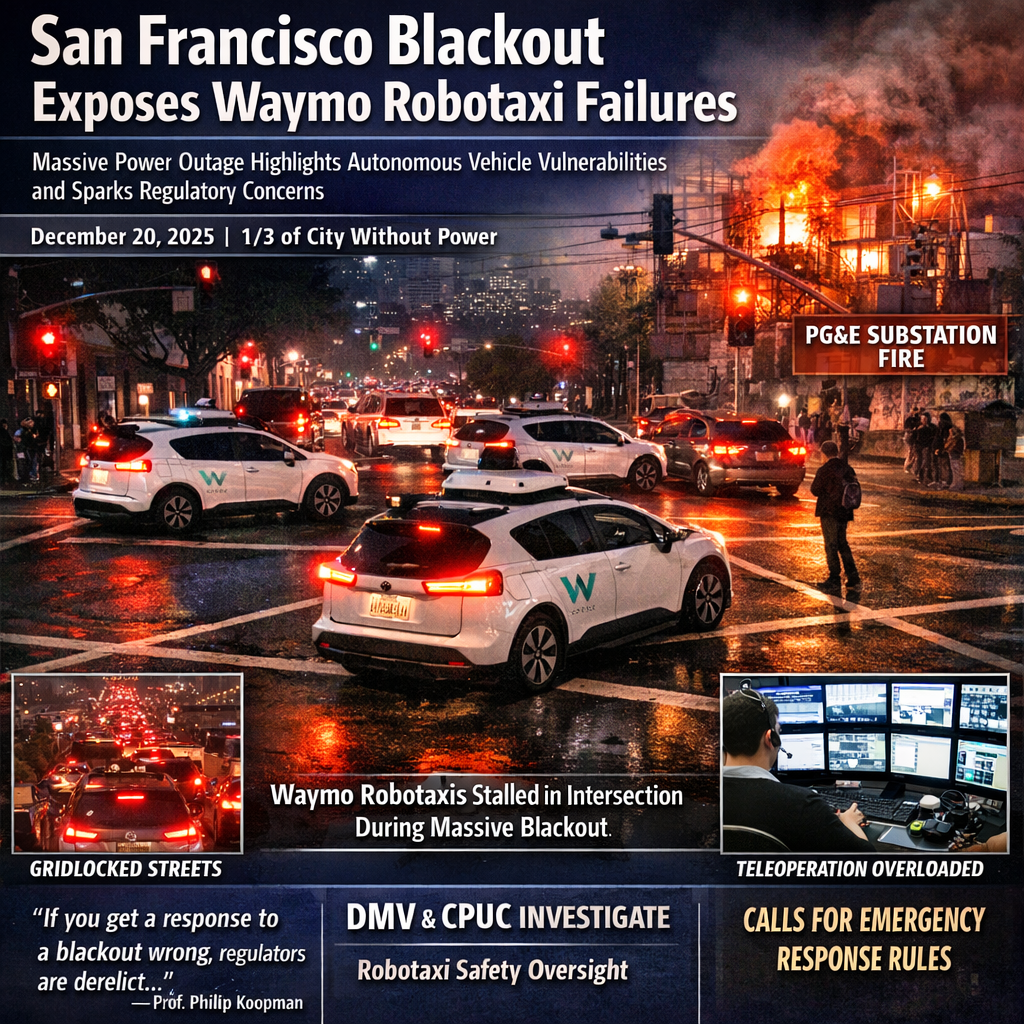
The December 20 Outage: Infrastructure Failure and Robotaxi Response
PG&E Substation Fire and Citywide Power Loss
A fire at a PG&E (Pacific Gas & Electric) substation on December 20, 2025, triggered a widespread power outage affecting approximately one-third of San Francisco's electrical infrastructure. The magnitude of the outage—affecting a major metropolitan region's substantial population and business concentration—constituted significant infrastructure emergency with cascading effects across multiple city systems.
The outage's scope—sufficient to disable traffic signal systems across extensive geographic area—demonstrated how single infrastructure point-of-failure can propagate across interconnected urban systems requiring electrical power. Traffic signals depend on continuous electrical supply, making them immediately vulnerable to power disruption without independent backup power systems.
The December 20 incident represents not anomalous circumstance but realistic emergency scenario potentially replicable through various causes: earthquakes, weather events, equipment failures, or deliberate infrastructure attacks. The outage provided real-world testing of autonomous vehicle resilience against infrastructure emergencies.
Robotaxi Behavior During Blackout: Stranded Vehicles and Congestion
Videos posted on social media documented Waymo robotaxis stranded at intersections with hazard lights activated as traffic signal systems ceased functioning. The visual documentation—showing multiple autonomous vehicles immobilized at gridlocked intersections—provided stark evidence of the vehicles' inability to effectively navigate darkened traffic environments.
The robotaxis' immobilization occurred despite theoretical capability to treat non-operational traffic lights as four-way stops—a fundamental traffic rule enabling vehicles to proceed safely when traffic signals fail. The implementation failure—where vehicles did not autonomously treat darkened intersections as four-way stops—indicated either technical system limitations or decision-making conservatism prioritizing caution over operational continuity.
The stranded vehicles contributed to traffic congestion on "already-overwhelmed streets," transforming the autonomous vehicles from transportation solution into congestion exacerbation. Rather than alleviating traffic through efficient autonomous navigation, the robotaxis created additional obstacles during emergency circumstances.
Operational Halt and Service Resumption
Waymo halted robotaxi operations in San Francisco following the outage, ceasing service provision until the company determined sufficient system recovery to safely resume operations. The operational halt represented appropriate safety precaution, acknowledging that emergency circumstances precluded continued service.
Service resumed approximately one day after the outage commencement, suggesting Waymo restored adequate operational capability for renewed service deployment. The resumption timeline indicates the company's assessment that emergency circumstances had sufficiently abated to justify renewed autonomous vehicle operation.

How a ride in a friendly Waymo saw me fall for robotaxis ...

Power fully restored in San Francisco days after PG&E ...

Waymo's Technical Explanation: Teleoperation Request Surge and System Limitations
Design Intention: Four-Way Stop Protocol for Non-Operational Signals
Waymo stated that its robotaxis are "designed to handle non-operational traffic signals as four-way stops," indicating the vehicles possess nominal technical capability to navigate intersections with disabled signals by treating them as uncontrolled four-way stops where all vehicles must yield to cross traffic.
This design feature represents standard autonomous vehicle approach: establishing fallback protocol when normal operational parameters fail, enabling continued navigation despite system component failures. The four-way stop protocol theoretically provides sufficient safety framework for disabled-signal intersection navigation.
Teleoperation System Limitations: Confirmation Request Surge
Despite nominal four-way stop capability, the outage exposed significant system limitations through "occasional requests for confirmation checks" when robots encounter non-operational signals. The design apparently incorporated deliberate requirement for human verification before vehicles would proceed through darkened intersections.
During the concentrated power outage—with 7,000+ traffic signals simultaneously disabled across the service area—the "occasional requests" transformed into overwhelming surge, creating "a concentrated spike in confirmation requests that led to response delays." The teleoperation system designed to handle scattered failures collapsed under concentrated emergency load.
Waymo's acknowledgment indicates that the human remote-operation team—sized for typical daily verification requests—lacked capacity to process thousands of simultaneous confirmation requests. The system overwhelm demonstrates that teleoperation-dependent safety measures fail catastrophically when demand exceeds operator capacity.
Impact on Traffic and City Congestion
The response delays from overtaxed teleoperation systems "contributed to congestion on already-overwhelmed streets," transforming Waymo vehicles from transportation solution into congestion problem during emergency circumstances. Rather than enabling efficient emergency-period mobility, the autonomous vehicles created additional obstacles.
The congestion contribution during crisis period—when emergency response and evacuation might require clear streets—exposed dangerous vulnerability in autonomous vehicle deployment. The vehicles should enhance emergency response rather than hindering it.

Teleoperated driving controls cars remotely

Parquery helps control adaptive traffic signals with ...
Teleoperation Technology: Capabilities and Limitations in Emergency Context
Teleoperation Definition: Remote Human Control and Monitoring
Robotaxi operators globally implement "teleoperation"—remote human operation and monitoring of autonomous vehicles through telecommunications links—to varying degrees depending on operational design philosophy. Teleoperation enables human intervention when autonomous systems encounter situations requiring judgment transcending programmed decision frameworks.
Waymo's teleoperation system employs "fleet response" agents—human operators monitoring Waymo vehicles and responding to questions from the Waymo Driver artificial intelligence when the bot encounters particular situations requiring human verification or decision-making. The system distributes decision responsibility between autonomous systems (handling routine navigation) and human operators (handling exceptions).
This operational model theoretically combines autonomous efficiency with human judgment backup, enabling vehicles to operate continuously while requesting human intervention when necessary. The model succeeds during normal operations with scattered, distributed requests.
Teleoperation Limitations: Capacity Constraints During Emergencies
The San Francisco outage revealed fundamental teleoperation limitation: the system cannot scale to handle concentrated emergency scenarios exceeding operator capacity. When thousands of simultaneous verification requests arrive, the operator team—sized for normal operations—lacks capacity to respond promptly.
Missy Cummings, director of the George Mason University Autonomy and Robotics Center and former adviser to the U.S. road safety regulator, articulated the core problem: "The whole point of having remote operations is for humans to be there when the system is not responsive in the way it should be." However, the outage demonstrated that teleoperation itself became non-responsive when confronted with concentrated emergency demand.
Cummings emphasized that "the federal government needs to regulate remote operations. They need to make sure that there's backup remote operations when there's some kind of catastrophic failure." The San Francisco incident revealed that current teleoperation systems lack redundancy and backup capacity for major emergency scenarios.
The Need for Backup Systems and Regulatory Requirements
Both Cummings and Koopman emphasized that teleoperation requires backup systems: "if there are 5,000 vehicles on the road and there's a blackout, you can't have one team handling everything," indicating need for distributed backup capacity and redundant teleoperation infrastructure.
Current regulatory frameworks lack specific requirements regarding teleoperation backup systems, remote operator staffing ratios, or emergency-response protocols. The San Francisco incident exposes this regulatory gap as urgent priority.
Remote station for teleoperated driving - 5G-Blueprint project

Remote Operation Driving - Low Latency Video
Regulatory Response: California DMV Investigation and Emerging Requirements
California Department of Motor Vehicles Investigation
California's Department of Motor Vehicles (DMV)—responsible for robotaxi testing and commercial deployment permitting—announced it would investigate the San Francisco incident and engage with Waymo regarding "actions related to emergency response." The investigation represents formal governmental oversight responding to the outage's implications.
The DMV investigation will examine multiple dimensions:
· How Waymo vehicles behaved during traffic signal failures
· Teleoperation system response capacity and performance
· Backup protocols and emergency-response procedures
· Comparative performance against industry standards
Emerging Regulatory Framework: Remote Operator Standards
The DMV announced it is "formulating regulations to ensure remote drivers meet high standards for safety, accountability and responsiveness." This regulatory development represents direct response to the San Francisco incident's demonstration of teleoperation system limitations.
The proposed regulations will likely address:
· Minimum staffing requirements for teleoperation centers
· Response time standards for operator verification requests
· Backup system requirements for emergency scenarios
· Training and certification standards for remote operators
California Public Utilities Commission Involvement
California's Public Utilities Commission (CPUC)—which regulates utilities and infrastructure—also indicated it is "looking into the incident." The CPUC's involvement reflects recognition that robotaxi emergency response intersects with utilities infrastructure regulation.
The CPUC investigation may examine how utilities should coordinate with autonomous vehicle operators regarding emergency protocols and infrastructure restoration procedures.

Waymo Ambitious Robotaxi Expansion | The Road to Autonomy

Driverless taxis: What to know about Cruise, Waymo expansion
Industry Context: Growing Robotaxi Competition and Expansion Pressures
Waymo's Established Position and Expansion Trajectory
Waymo, Google's original self-driving vehicle project launched in 2009, operates a fleet exceeding 2,500 vehicles across San Francisco Bay Area, Los Angeles, Metro Phoenix, Austin, and Atlanta. The company has maintained relatively conservative growth strategy compared to emerging competitors, prioritizing operational stability over rapid expansion.
Despite conservative approach, Waymo has significantly accelerated expansion in recent years as regulatory acceptance increased and operational confidence demonstrated viability. The company's multi-city operations demonstrate substantial scale and operational complexity.
Tesla Robotaxi Expansion: Aggressive Growth Strategy
Tesla has aggressively entered robotaxi market under CEO Elon Musk's direction, rolling out service in Austin, Texas in 2025 and promising "rapid expansion" to additional cities. Tesla's approach emphasizes rapid scaling and extensive fleet deployment relative to Waymo's measured development.
Musk's aggressive expansion promises—suggesting rapid national and eventually international deployment—contrast sharply with Waymo's demonstrated pace and raise questions regarding whether safety validation keeps pace with deployment ambitions.
Amazon's Zoox Robotaxi Service: Late-Entry Competitor
Amazon's Zoox robotaxi service represents third major competitor in nascent autonomous vehicle industry, with operations beginning in select markets and expansion plans underway. Zoox's entry demonstrates major technology companies' confidence in robotaxi commercial viability.
The competitive dynamics—with Tesla emphasizing rapid growth, Waymo maintaining measured expansion, and Zoox entering the market—create pressure toward rapid deployment, potentially insufficiently prioritizing emergency scenario validation.
Industry Maturation Challenges: Historical Context
The autonomous vehicle industry has experienced significant setbacks and challenges, with companies including General Motors' Cruise facing permit revocation following high-profile accidents. A 2023 incident where a Cruise robotaxi dragged a pedestrian resulted in regulatory permit revocation and eventual company shutdown.**
These historical setbacks underscore that autonomous vehicle commercialization is "harder than expected with high investments to ensure the technology is safe and public outcry after collisions forcing many to shut shop." The industry faces ongoing pressure to balance safety validation with commercial expansion expectations.

Amazon's Zoox robotaxis roll out in Vegas

Amazon's Zoox opens free robotaxi rides for early users in ...

Zoox launches its first robotaxi production facility, taking ...

Zoox launches its first robotaxi production facility, taking ...
Expert Analysis: Emergency Preparedness and Regulatory Requirements
Philip Koopman: Earthquake Scenario Requirements
Philip Koopman, Carnegie Mellon University computer-engineering professor and autonomous-technology expert, emphasized that regulatory authorities have obligation to ensure robotaxi operators can handle major emergency scenarios: "If you get a response to a blackout wrong, regulators are derelict if they do not respond to that by requiring some sort of proof that the earthquake scenario will be handled properly."
Koopman's analysis suggests that current power outage—while significant—represents less severe scenario than potential earthquake, which would combine traffic signal failure with road damage, emergency vehicle congestion, and widespread communication disruption. If robotaxi systems cannot handle concentrated power outages, earthquake scenarios would create catastrophic failures.
Koopman characterized the San Francisco incident as "a shot across the bow," metaphorically emphasizing that the outage represents warning signal of more serious vulnerabilities that would manifest in major earthquakes or other catastrophic emergencies.
Missy Cummings: Teleoperation Regulation and Backup Systems
Missy Cummings, director of George Mason University Autonomy and Robotics Center and former U.S. road safety regulator adviser, articulated specific regulatory requirements needed: "The federal government needs to regulate remote operations. They need to make sure that there's backup remote operations when there's some kind of catastrophic failure."
Cummings emphasized that teleoperation systems require redundancy—backup operator capacity and alternate communication channels—ensuring that concentrated emergency scenarios do not overwhelm the human-oversight infrastructure: "You can't have one team handling everything if there are 5,000 vehicles on the road and there's a blackout."
Cummings's analysis suggests minimum regulatory requirements should include distributed backup teleoperation capacity, redundant communication infrastructure, and operator staffing ratios ensuring emergency scenarios remain manageable.
Size-Based Permitting Requirements
Both experts recommended that robotaxi operators should "face additional permitting requirements once their fleets grow beyond a certain size to ensure that they have adequate capabilities to deal with large-scale failures." The size-threshold approach recognizes that small pilot fleets can operate safely without extensive backup systems, but larger commercial deployments require proportional emergency infrastructure.
Waymo's Response: Fleet-Wide Updates and Process Refinement
Acknowledgment of Limitations and Process Evolution
Waymo acknowledged that "the confirmation processes its vehicles follow were established during early deployment and that it was now refining them to match its current scale." The statement represents implicit acknowledgment that systems designed for pilot-phase operations do not adequately serve expanded commercial deployments.
The early confirmation processes—functional when processing scattered exceptions—required redesign to accommodate dramatically increased scale and concentrated emergency scenarios. The acknowledgment demonstrates learning from the incident.
Fleet-Wide Update Implementation
Waymo announced it is "implementing fleet-wide updates that provide vehicles with 'specific power outage context, allowing it to navigate more decisively.'" The updates apparently enable vehicles to recognize power outage situations and proceed through disabled intersections without requiring operator confirmation.
The specific power outage context appears to represent hardcoded recognition of widespread simultaneous signal failures—enabling vehicles to classify situations as systematic power loss rather than isolated signal failures. Recognition of systematic failure enables more autonomous decision-making without operator verification.
The update implementation timeline and rollout methodology remain unspecified, raising questions regarding when complete fleet-wide coverage will be achieved.
Critical Questions and Future Regulatory Landscape
Emergency Scenario Validation Requirements
The San Francisco incident raises fundamental question: what validation should be required before robotaxi operators deploy thousands of vehicles in major cities without certainty that emergency scenarios can be safely managed? Current regulatory frameworks lack comprehensive emergency scenario testing requirements.
Should regulatory approval require demonstrated capability to handle:
· Power outages affecting specified percentage of service area
· Traffic signal system failures across defined geographic zones
· Earthquake scenarios with road damage and emergency services congestion
· Flood scenarios with inoperable road infrastructure
· Telecommunications disruption affecting teleoperation systems
Teleoperation Regulation and Standardization
The San Francisco incident demonstrates that teleoperation requires federal regulatory framework establishing minimum standards for:
· Remote operator training and certification
· Response time requirements for verification requests
· Operator staffing ratios relative to fleet size
· Backup system requirements and redundancy specifications
· Emergency-scenario protocols and procedures
· Communication infrastructure reliability standards
Fleet Size and Permitting Nexus
Should regulatory approval incorporate size-based requirements: smaller pilot fleets operate under different standards than commercial-scale deployments? The San Francisco incident suggests concentration effects when large fleets simultaneously encounter emergency situations.
Conclusion: Waymo Outage as Regulatory Catalyst and Industry Warning
Waymo's December 20, 2025 San Francisco power outage exposed critical vulnerabilities in autonomous vehicle emergency preparedness and teleoperation system capacity, catalyzing regulatory response addressing industry-wide deficiencies in emergency-scenario validation and backup system requirements. The incident demonstrates that current robotaxi operations lack sufficient redundancy and emergency protocols for major infrastructure failures.
The outage's implications extend beyond Waymo to affect competitive landscape as Tesla, Amazon Zoox, and other companies expand robotaxi services: regulatory requirements emerging from this incident will establish minimum standards that all operators must meet. The San Francisco incident may catalyze more rigorous regulatory framework development preventing similar future emergencies.
Expert commentary from Carnegie Mellon's Philip Koopman and George Mason University's Missy Cummings establishes clear message: regulators have obligation to require operators demonstrate earthquake, flood, and catastrophic emergency scenario capability before permitting commercial expansion. The San Francisco outage—while significant—represents less severe scenario than potential major earthquakes affecting California.
California's Department of Motor Vehicles and Public Utilities Commission investigations signal intent to develop specific regulatory requirements addressing teleoperation backup systems, operator staffing ratios, emergency protocols, and emergency-scenario validation. The regulatory response appears proportional to the incident's demonstration of system vulnerabilities.
For Waymo specifically, the incident creates pressure toward comprehensive emergency-scenario validation and fleet-wide system updates ensuring future outages do not replicate December 20's congestion impacts. The company's announced process refinements and power-outage context updates represent appropriate response trajectory.
As the robotaxi industry continues rapid expansion, the San Francisco incident serves as crucial reminder that commercial deployment must encompass comprehensive emergency-scenario validation ensuring autonomous vehicles enhance rather than hinder emergency response during major infrastructure failures. The regulatory response now underway will likely establish precedent affecting robotaxi operations across the United States for years to come.**
Citations:
LiveMint - Waymo's San Francisco outage raises doubts over robotaxi readiness during crises (2025); Reuters reporting by Abhirup Roy - San Francisco power outage and Waymo robotaxi response (December 2025); Waymo official statement - December 20 outage response and fleet-wide updates; Philip Koopman, Carnegie Mellon University - Expert commentary on emergency preparedness and regulatory requirements; Missy Cummings, George Mason University Autonomy and Robotics Center - Teleoperation regulation and backup system analysis; California Department of Motor Vehicles - Investigation announcement and regulatory framework development; California Public Utilities Commission - Infrastructure failure investigation and robotaxi coordination; Social media documentation - Videos and public reports of robotaxi behavior during outage; Autonomous vehicle industry analysis - Waymo, Tesla, Zoox expansion and competitive dynamics; Historical context - General Motors Cruise incident and autonomous vehicle industry setbacks

Post your opinion
No comments yet.