Gold and Silver Hit Fresh Record Highs Amid Geopolitical Tensions and Weakening US Dollar: Complete Market Analysis
Record Precious Metals Price Levels: Breaking Previous Highs
Gold Reaches All-Time Peak: $4,531.24 Per Ounce
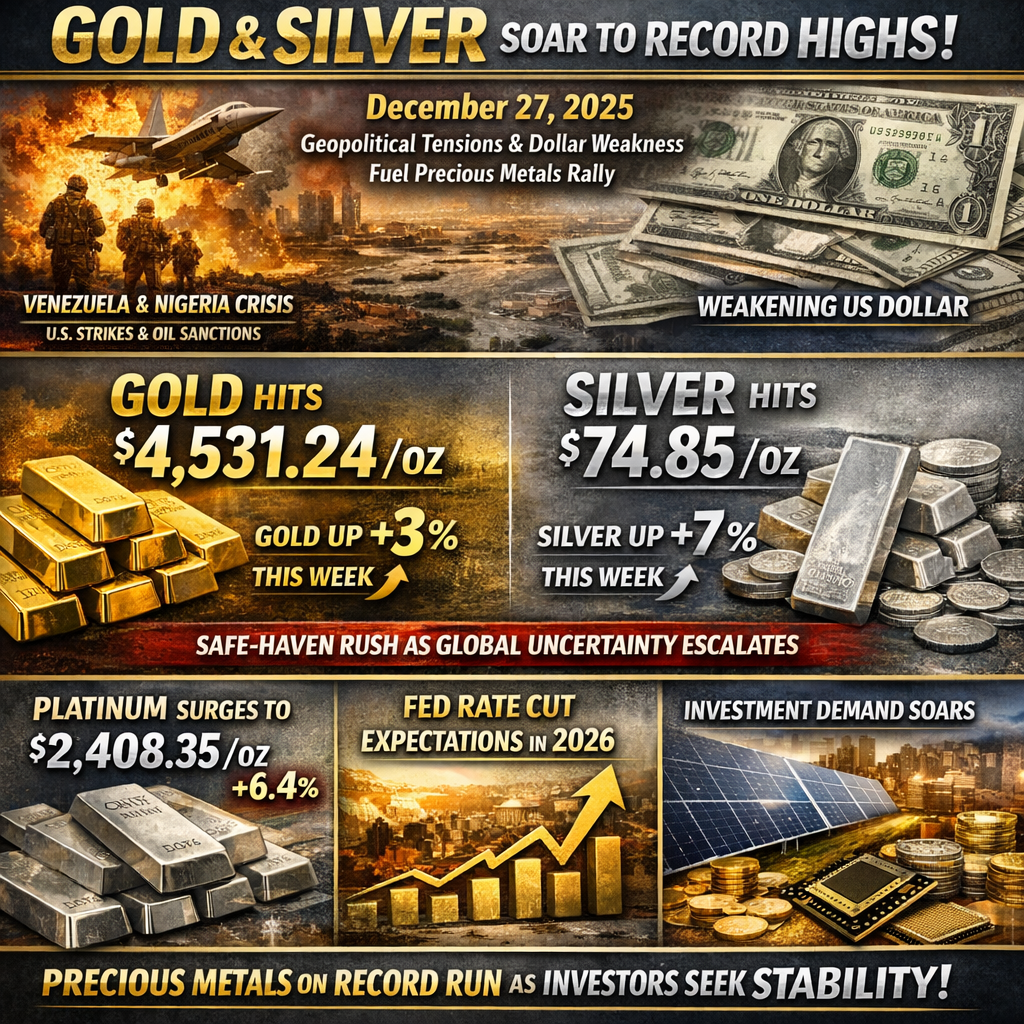
Spot gold achieved fresh all-time record high of $4,531.24 per ounce on December 27, 2025, surpassing previous market peaks and establishing new benchmark price ceiling for the precious metal. The record breakthrough—following months of sustained strength throughout 2025—represents culmination of powerful year-end rally as investors rotated toward safe-haven assets amid escalating global uncertainties.
Trading data as of 09:30 ET (15:30 GMT) showed spot gold at $4,527.76 per ounce—marginally below the intraday peak but still maintaining historically elevated price levels. The proximity of trading prices to all-time highs demonstrates sustained investor demand despite marginal pullback from absolute peak.
US Gold Futures for February 2026 delivery registered even stronger positioning at $4,562.75, reflecting investor expectations regarding continued gold strength and futures market pricing incorporating anticipated supply-demand dynamics and geopolitical continuation. The futures premium above spot price indicates market expectations of gold price stability or appreciation through February delivery month.
Silver Surges Past Previous Records: $74.85 Per Ounce
Spot silver exploded to fresh all-time record high of $74.85 per ounce, surging 4.2% in single trading session and establishing new silver price benchmark unmatched in recorded commodity trading history. The silver surge—substantially outpacing gold's 1.1% daily gain—reflected amplified safe-haven demand combined with industrial utility expectations.
Silver's extraordinary 4.2% single-session leap positioned the precious metal to jump over 7% during the complete trading week, demonstrating exceptional momentum and investor enthusiasm for silver as safe-haven asset with dual industrial applications. The weekly surge substantially exceeded gold's approximately 3% weekly advance, indicating market recognition of silver's unique positioning.
The silver outperformance relative to gold suggests investor sophistication regarding precious metals differentiation: while gold provides pure safe-haven defensive appeal, silver combines safety characteristics with genuine industrial utility creating dual-demand foundation. This differentiation drives comparative strength during periods of geopolitical anxiety.
Platinum Records Strong Gains: $2,408.35 Per Ounce
Platinum spot prices advanced 6.4% to $2,408.35 per ounce, recording strongest gains among major precious metals and reflecting broad-based safe-haven asset appreciation. Platinum's 6.4% surge exceeded both gold (1.1%) and silver (4.2%) percentage gains during the same trading period, positioning platinum as strongest performer among precious metals.
Platinum's robust performance reflects its dual characteristics similar to silver: safe-haven appeal during geopolitical uncertainty alongside significant industrial applications in automotive catalytic converters and industrial manufacturing. The dual-demand foundation supports stronger percentage appreciation relative to gold's pure safe-haven positioning.
|
Metal |
Intraday Change |
Price Level |
New Record? |
|
Gold |
+1.1% |
$4,527.76/oz |
Yes - $4,531.24 |
|
Silver |
+4.2% |
$74.85/oz |
Yes - Record High |
|
Platinum |
+6.4% |
$2,408.35/oz |
Strong Gains |

Gold bullion bars, precious metal investment as a store of ...

How To Buy Gold Bars

Geopolitical Tensions as Primary Market Driver
Venezuela Oil Export Pressure: Regional Instability Catalyst
The US government escalated diplomatic and economic pressure against Venezuela's crude oil export operations, triggering immediate investor concerns regarding potential supply disruptions, geopolitical destabilization, and broader Latin American regional instability. The Venezuela policy shift represented significant geopolitical development in major oil-producing nation with substantial global energy market influence.
Investor anxiety regarding Venezuela-related supply disruptions extends beyond petroleum sector to encompass broader regional security concerns and US military intervention potential. The escalated pressure signals US willingness to engage increasingly aggressive economic and potentially military measures against geopolitically significant nations.
The Venezuela development catalyzed safe-haven asset demand as investors protected portfolios against potential energy market disruption, regional conflict escalation, and broader geopolitical destabilization that could affect global financial systems. The policy uncertainty drove portfolio reallocation toward precious metals providing inflation and geopolitical protection.
Nigeria Military Strikes: Demonstrated US Force Projection
President Trump announced through social media that US military forces had conducted strikes against militant targets in Nigeria, representing significant geopolitical statement regarding Washington's demonstrated willingness to deploy military force across multiple regions simultaneously. The Nigeria announcement came shortly after Venezuela pressure escalation, suggesting coordinated or sequential geopolitical assertions.
The timing of Nigeria military action—combined with Venezuela pressure—created consolidated geopolitical anxiety narrative: multiple regions facing US military and economic pressure, suggesting potential for broader conflict escalation or destabilization. The cumulative effect drove substantial investor flight toward safe-haven assets.
Investor interpretation of US military strikes in Nigeria encompassed concerns regarding continental African instability, potential militant group response or retaliation, and broader regional conflict possibilities. The geopolitical anxiety created demand for precious metals as portfolio insurance against escalating global tensions.
Cumulative Geopolitical Effect: Safe-Haven Demand Surge
The combined Venezuela pressure and Nigeria military action created consolidated perception of escalating geopolitical tensions across multiple world regions, driving systematic investor shift toward safe-haven asset classes including precious metals, Treasury securities, and other stability-providing investments. The psychological effect—perception of broadening geopolitical uncertainty—exceeded the individual significance of each development.
Market participants interpreted the sequential announcements as indication of broader US military and economic assertiveness, raising concerns regarding potential conflict escalation and systematic global instability. The cumulative perception drove portfolio reallocation magnitude exceeding that which single geopolitical event would trigger.

Gold As A Safe Haven In Times Of Geopolitical Tensions | TNFX

What is a Safe-Haven Asset? – Shafaat Ali Education
US Dollar Weakness: Currency Depreciation Supporting Precious Metals
Dollar Slippage Against Major Currency Baskets
The US dollar weakened against comparative basket of major currencies including Euro, British Pound, Japanese Yen, and Swiss Franc, establishing downward pressure on the globally-dominant reserve currency. The broad-based dollar weakness—affecting multiple currency pairs simultaneously—indicates systematic weakness rather than isolated pairwise currency movements.
Dollar depreciation accelerated amid growing market expectations that the Federal Reserve will initiate monetary easing cycles in 2026 as inflation shows moderation signals and economic growth projections decline. The expectation of rate-cutting—reducing US interest rate advantage relative to other developed economies—creates depreciation pressure on the dollar.
Technically, the dollar's performance against major currencies reflects significant decline from previous strength, with market participants recognizing that historical dollar strength advantage has substantially compressed as Fed rate expectations decline. The currency technical weakness combines with macroeconomic fundamentals creating downward pressure.
Fed Rate-Cut Expectations: Monetary Policy Pivot Catalyst
Growing market consensus emerged during late 2025 that the Federal Reserve will begin lowering policy interest rates in 2026, representing significant shift from earlier 2025 rate-holding stance and reflecting recognition that inflation has cooled substantially from 2022-2023 peaks. The rate-cut expectations represent major monetary policy pivot affecting global asset allocation.
The Fed's anticipated rate reductions derive from multiple factors: inflation cooling toward 2% target, economic growth moderation, labor market softening, and recognition that aggressive 2022-2023 tightening has achieved primary inflation-control objectives. The policy normalization—moving from restrictive to accommodative stance—creates environment supporting dollar weakness and precious metals strength.
Market participants price Fed rate reductions into asset allocation by shifting from interest-rate-sensitive investments (which benefit from higher rates) toward alternative assets including precious metals, commodities, and inflation hedges that benefit from accommodative monetary environments. The systematic reallocation drives precious metals demand.
Lower Treasury Yields and Non-Interest-Bearing Assets
US Treasury yields declined amid rate-cut expectations, reducing the yield advantage of interest-bearing Treasury securities relative to non-interest-bearing assets such as gold. Lower yields diminish the opportunity cost of holding precious metals that generate no interest or dividend income.
The yield compression—reflecting Treasury market repricing of Fed easing expectations—creates relative attractiveness for gold and precious metals by eliminating yield differential that had previously made Treasuries more attractive than precious metals. The valuation shift directly supports precious metals demand.
Investors reassessing portfolio structure recognize that lower Treasury yields eliminate previous yield advantage, driving reallocation toward precious metals offering capital appreciation potential without ongoing income generation. The portfolio rotation toward stores of value from yield-dependent securities intensifies precious metals demand.

The dollar's crown is slipping, and fast | Reuters

Monetary policy in 2025: dialling-back time
Industrial Applications and Dual-Demand Precious Metals
Silver's Industrial Utility: Electronics and Clean Energy
Silver's explosive 4.2% single-session surge—outpacing gold's 1.1% advance—reflects recognition of silver's unique market positioning combining safe-haven defensive appeal with genuine industrial utility in electronics manufacturing and clean-energy technologies. The dual-demand foundation provides stronger fundamental basis than gold's single safe-haven appeal.
Electronics industry applications include printed circuit board manufacturing, RFID tags, automotive electronics, and telecommunications infrastructure, with clean energy applications encompassing solar panel manufacturing as critical component in photovoltaic cell production. The industrial demand foundation—independent of precious metals investment demand—provides underlying support.
The anticipated growth in renewable energy deployment and electric vehicle proliferation creates long-term structural demand for silver in photovoltaic cells and battery technologies, supporting price expectations independent of temporary geopolitical considerations. The industrial structural growth creates bullish long-term outlook.
Platinum's Automotive and Industrial Demand
Platinum's 6.4% surge—strongest among major precious metals—reflects similar dual-demand positioning: safe-haven appeal combined with significant industrial applications in automotive catalytic converters, industrial chemical production, and petroleum refining. The industrial applications provide structural demand supporting platinum strength.
Automotive catalytic converter applications represent major platinum demand source as emission control regulations mandate catalytic converter usage in internal combustion vehicles globally. The regulatory requirement creates stable structural demand regardless of precious metals investment cycles.
Industrial manufacturing applications including chemical production catalysts, laboratory equipment, and specialized manufacturing equipment create distributed demand base supporting platinum prices independent of safe-haven investment flows. The diversified demand foundation provides stability during market dislocations.
Gold's Pure Safe-Haven Positioning
Gold's 1.1% single-session advance—lagging silver and platinum percentage gains—reflects its market positioning as pure safe-haven asset without significant industrial applications or structural demand foundation. The limited industrial utility means gold prices depend almost exclusively on investor demand for portfolio protection and inflation hedging.
However, gold's pure safe-haven positioning provides unambiguous defensive appeal during geopolitical crises and economic uncertainty, establishing gold's unique role as ultimate confidence asset and crisis hedge. The singularity of purpose creates reliable demand during maximum market stress.

Precious Metal Market Trends & Forecasts - 2032
Trading Conditions and Market Dynamics: Holiday-Thinned Liquidity
Holiday Period Trading Effects: Exaggerated Price Movements
The precious metals price surge occurred during historically thin holiday trading conditions when many market participants reduce positions, vacation, or shift attention toward holiday activities rather than active trading. The reduced liquidity creates environment where standard transaction sizes generate disproportionate price impacts.
Investment inflows during holiday-thinned trading generate exaggerated price movements as normal supply-demand balancing mechanisms become less effective when typical trading volume declines substantially. The thin liquidity magnifies both upward and downward price swings relative to normal market conditions.
The December holiday period typically exhibits lowest trading volumes of calendar year, with traders on vacation and institutional investors reducing activity levels through year-end. The systematically reduced liquidity creates conditions favoring sharp price swings and records that might be mitigated during normal liquidity levels.
Strong Investment Inflows During Uncertainty
Despite holiday period's typical slow trading, strong investment inflows into precious metals overwhelmed reduced liquidity, driving prices sharply higher as demand exceeded available supply at previous price levels. The demand intensity overcame structural liquidity constraints.
The investment inflows reflected systematic rotation toward safe-haven assets amid geopolitical anxiety, with portfolio managers and individual investors simultaneously seeking precious metals exposure creating concentrated demand period. The synchronized demand—concentrated into short period—generated record prices.
Limited Availability Amplifying Price Moves
Precious metals supply constraints—particularly for physical silver and platinum—amplified price movements during high-demand periods by limiting sellers' ability to absorb rapid demand increases. The supply inelasticity created conditions favoring sharp price appreciation.
Physical precious metals availability faces structural constraints: mining production requires multi-year development, recycling sources remain limited, and warehouse inventory levels demonstrate limited abundance. The supply constraints support continued strength as demand surge cannot be met through rapid supply increases.

Monetary policy in 2025: dialling-back time

Trump Wants a Weaker Dollar. Getting One Isn't So Easy ...
Analyst Outlook: Fundamental Support for Continued Strength
Broader Fundamentals Supporting Extended Rally
Analysts expressed confidence that "the broader fundamentals point to continued strength in gold and silver into the new year," indicating that the record prices reflect fundamental factors rather than mere technical or sentiment-driven spikes. The fundamental support encompasses multiple reinforcing factors.
The fundamental foundation includes:
· Geopolitical uncertainty likely to persist into 2026 as regional tensions remain unresolved
· Monetary easing cycle anticipated to begin 2026 as Fed initiates rate reductions
· Dollar weakness expected to continue amid accommodation expectations
· Inflation protection demand as investors seek hedges against residual inflation
· Portfolio insurance demand as investors protect against potential market dislocations
The multiple fundamental supports suggest that the record prices represent sustainable new price levels rather than temporary spikes likely to reverse quickly.
2026 Outlook: Continued Precious Metals Strength Expectations
Market consensus appears to favor continued precious metals strength extending into 2026, with analysts pointing to multiple supporting factors likely to remain in place through next year. The outlook reflects confidence in sustained demand drivers.
Key expected 2026 factors supporting precious metals include:
· Fed rate reductions beginning potentially in early 2026 supporting dollar weakness
· Continued geopolitical tensions in Venezuela, Nigeria, Middle East, and potentially other regions
· Growth in industrial demand for silver in renewable energy and electronics
· Inflation protection demand as investors seek long-term value preservation
· Central bank demand for gold reserves as geopolitical tensions encourage reserve diversification
The multifaceted support structure suggests precious metals prices could reach significantly higher levels during 2026 if geopolitical tensions persist and Fed easing proceeds as markets expect.
Investment Implications: Portfolio Considerations During Precious Metals Rally
Safe-Haven Asset Allocation: Risk Protection Benefits
Investors considering precious metals exposure should recognize that safe-haven demand during geopolitical uncertainty provides genuine portfolio insurance benefit, reducing overall portfolio volatility during market stress periods. The defensive characteristics create meaningful risk-management function.
Portfolio allocation models increasingly recognize precious metals as essential diversification component providing negative correlation to equities during market downturns. The negative correlation—precious metals strengthening when equities decline—creates risk-reduction benefit.
Geopolitical uncertainty creating current precious metals strength demonstrates precisely the scenario where safe-haven assets provide maximum utility: rapid market dislocations forcing portfolio rebalancing toward stability-providing assets. The current environment exemplifies precious metals' intended diversification role.
Dollar Weakness Implications: Currency Hedge Considerations
Investors holding substantial dollar-denominated assets should consider precious metals as hedge against potential currency depreciation, with weak-dollar environment amplifying precious metals price strength for investors holding alternative currencies. The currency hedge function complements safe-haven characteristics.
For international investors holding euros, pounds, yen, or other currencies, the weak-dollar environment makes precious metals increasingly expensive in local currency terms, yet the purchase provides hedge against further dollar depreciation. The trade-off between higher precious metals prices and currency protection creates nuanced decision framework.
Conclusion: Record Precious Metals Prices Amid Structural Uncertainty
Gold, silver, and platinum hit fresh all-time record highs on December 27, 2025, reaching $4,531.24, $74.85, and $2,408.35 per ounce respectively as investors systematically rotated toward safe-haven assets amid escalating geopolitical tensions in Venezuela and Nigeria, weakening US dollar, and anticipated Federal Reserve monetary easing in 2026. The record price breakthrough represents culmination of powerful year-end precious metals rally driven by multiple reinforcing fundamental factors.
The geopolitical catalyst—combining Venezuela oil pressure and Nigeria military strikes—created perception of broadening global uncertainty, triggering systematic investor flight toward precious metals as portfolio insurance against potential conflict escalation and regional instability. The psychological impact of consolidated geopolitical anxiety drove demand magnitude exceeding single isolated events.
Dollar weakness fundamentally supporting precious metals strength reflects growing market certainty regarding Federal Reserve rate-cut initiation in 2026, with easing cycles historically supporting precious metals demand by reducing interest-rate opportunity cost of holding non-yielding gold and silver. The monetary policy pivot creates structural support for sustained strength.
Silver and platinum's outperformance relative to gold reflects investor recognition of dual-demand positioning: safe-haven appeal combined with genuine industrial utility in electronics, clean energy, and automotive applications, creating structural demand foundation beyond pure investment sentiment. The fundamental differentiation supports expectation of sustained relative strength.
As holiday period concludes and normal trading liquidity resumes in 2026, analysts expect precious metals strength to continue as geopolitical tensions persist, Fed easing begins, and industrial demand for silver and platinum accelerates through renewable energy and clean technology expansion. The outlook suggests record prices may represent only initial phase of sustained precious metals appreciation.
For investors seeking portfolio protection against geopolitical uncertainty, currency depreciation, and inflation risks, the current precious metals environment presents opportunity to establish positions at elevated prices justified by fundamental support rather than mere sentiment-driven spikes. The record highs reflect genuine reassessment of precious metals' portfolio role in uncertain global environment.**
Citations:
Investing.com - Gold, silver hit fresh record highs amid geopolitical tensions, weak dollar (December 27, 2025); Spot commodity price data - Gold $4,531.24/oz, Silver $74.85/oz, Platinum $2,408.35/oz records; Federal Reserve policy expectations - Market consensus regarding 2026 rate-cut initiation; US dollar analysis - Currency weakness against major currency baskets; Geopolitical analysis - Venezuela oil export pressure and Nigeria military strikes; Safe-haven asset analysis - Precious metals positioning during uncertainty; Industrial demand analysis - Silver electronics/clean energy applications, platinum automotive catalytic converters; Trading condition analysis - Holiday-thinned liquidity effects on price volatility; Analyst commentary - Fundamental support for continued precious metals strength; Monetary policy analysis - Fed easing expectations and implications for precious metals; Portfolio allocation guidance - Precious metals diversification and risk management benefits

Post your opinion
No comments yet.