Stock Market Top Gainers and Losers December 26, 2025: Titan Surges 2.17%, TCS and Shriram Finance Decline Amid FII Outflows
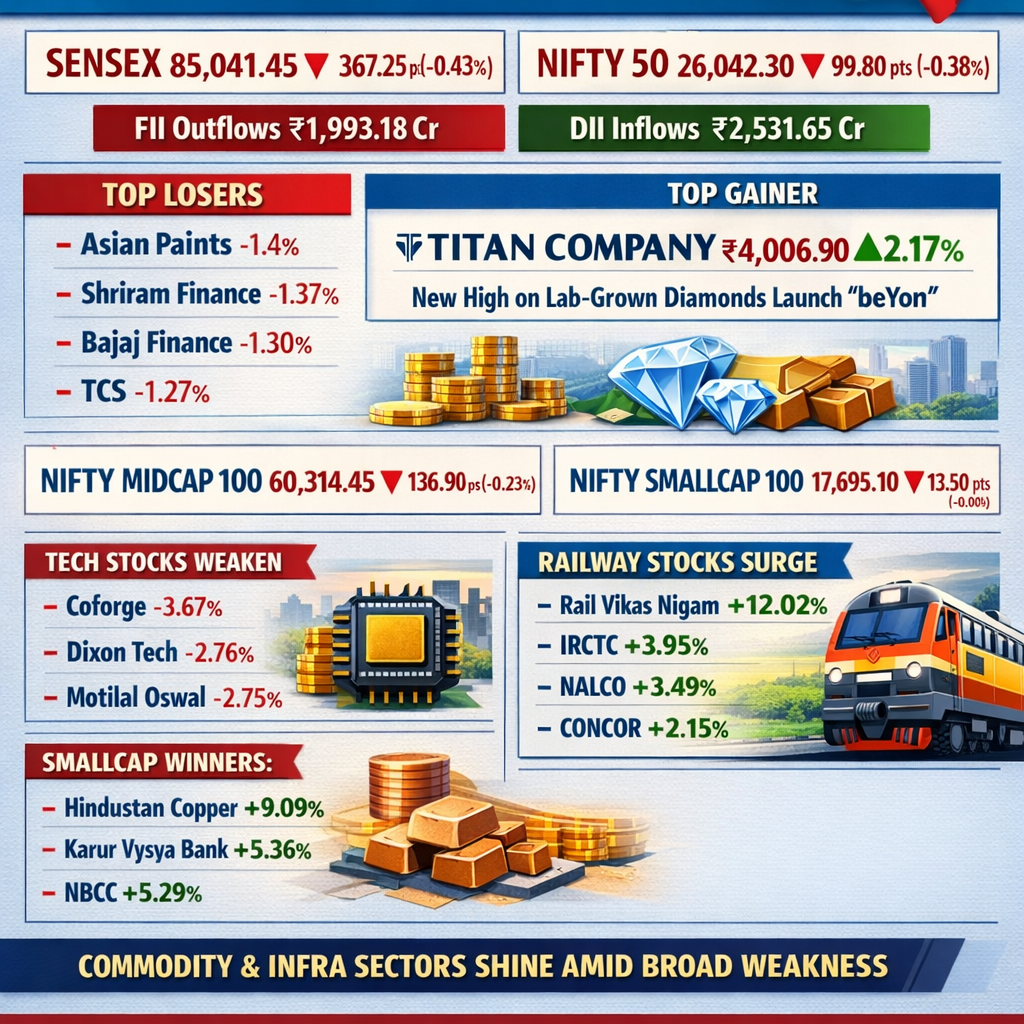
Market Overview: December 26, 2025 Session Performance
Benchmark Indices Performance: Negative Close Amid FII Selling Pressure
The Indian equity market's December 26, 2025 session concluded with notable weakness across primary indices, with BSE SENSEX declining 367.25 points (0.43%) to close at 85,041.45 and NSE NIFTY50 falling 99.80 points (0.38%) to end at 26,042.30, establishing clearly negative tone despite resilient domestic institutional buying attempting to offset foreign investor selling pressure. The negative close reflects macroeconomic headwinds and year-end profit-taking dynamics.
Key Index Performance Metrics:
|
Index |
Closing Points |
Change Points |
Change % |
Significance |
|
BSE SENSEX |
85,041.45 |
-367.25 |
-0.43% |
Largecap weakness |
|
NSE NIFTY50 |
26,042.30 |
-99.80 |
-0.38% |
Benchmark pressure |
|
NIFTY Midcap 100 |
60,314.45 |
-136.90 |
-0.23% |
Midcap softness |
|
NIFTY Smallcap 100 |
17,695.10 |
-13.50 |
-0.08% |
Smallcap resilience |
The negative close across largecap and midcap indices establishes consistent weakness, with smallcap resilience suggesting selective sector strength within defensive and commodity-exposed segments.
FII vs. DII Capital Flows: Institutional Investor Dynamics
Foreign institutional investor (FII) outflows totaled ₹1,993.18 crore on December 26, while domestic institutional investors (DIIs) demonstrated conviction with net purchases of ₹2,531.65 crore, establishing classic divergence where domestic institutional buyers attempt offsetting foreign selling pressure but prove insufficient to prevent index declines. The capital flow dynamics establish critical context for market direction.
Capital Flow Implications:
FII Selling Pressure:
· ₹1,993.18 crore outflows suggest risk reduction and portfolio rebalancing by foreign investors
· Timing coinciding with year-end and U.S. holiday season (post-Christmas)
· Potential concerns regarding emerging market exposure and currency risk
· Likely reflecting global portfolio rotation toward developed markets or defensive assets
DII Counter-Positioning:
· ₹2,531.65 crore inflows demonstrate domestic institutional confidence
· DIIs accumulating positions foreign investors liquidating
· Domestic asset allocators perceiving value at depressed price levels
· Systematic SIP (Systematic Investment Plan) contributions continuing despite market softness
Net Flow Impact:
· DII purchases of ₹2,531.65 crore exceed FII outflows of ₹1,993.18 crore by ₹538.47 crore
· Suggests underlying domestic demand could support floor for broader market decline
· However, FII pressure preventing index advancement despite DII support
The flow divergence—with DIIs buying while FIIs sell—establishes classic market structure where foreign capital represents marginal incremental demand and domestic institutions provide permanent capital base.

India markets regulator approved changes to derivative ...

National Stock Exchange of India - Wikipedia

Top Losers: Weakness in Quality Largecaps and Technology Stocks
Quality Largecap Declines: Defensive Stocks Failing to Provide Support
Shares of premium quality largecap stocks declined notably despite reputations as defensive holdings: Asian Paints fell 1.4%, Shriram Finance declined 1.37%, Bajaj Finance lost 1.30%, and TCS dropped 1.27%, establishing pattern where quality stocks proved vulnerable to selling pressure and provided no relative outperformance benefit despite typically defensive characteristics. The quality stock weakness establishes concerning signal regarding investor confidence.
Asian Paints Performance Analysis:
Company Background:
· Leading Indian paint manufacturer with domestic market dominance
· Premium brand positioning and superior distribution network
· Consistent dividend payer and cash-generative business model
· Typically defensive stock benefiting from consistent consumer spending
Decline Factors:
· 1.4% decline reflects broader paint sector weakness as real estate construction slows
· Rising input costs (pigments, additives) potentially compressing margins
· Monsoon-dependent business cycle concerns post-calendar year peak season
· Volume growth deceleration amid price realization challenges
Shriram Finance Stock Decline:
Company Background:
· Non-bank financial company (NBFC) specializing in retail lending
· Mortgage and personal finance focus with rapid growth trajectory
· Significant capital raising during 2024-2025 establishing scale
· Beneficiary of consumption recovery and lending cycle expansion
Decline Factors:
· 1.37% decline reflects NBFC sector profit-taking after extraordinary 2025 gains
· Rising interest rate concerns despite RBI easing cycle
· Asset quality questions emerging amid rapid growth periods
· Competition from banks increasingly offering competitive lending rates
Bajaj Finance Weakness:
Company Background:
· Large-cap NBFC with diversified lending portfolio
· Consumer durable financing, mortgage, and personal lending
· Extraordinary 2025 performance driving valuation expansion
· Beneficiary of consumption cycle recovery
Decline Factors:
· 1.30% drop reflects sector-wide profit-taking
· Valuation concerns at current elevated multiples
· Interest rate sensitivity with Fed easing cycle uncertainty
· Growth deceleration from pandemic-recovery highs
Tata Consultancy Services (TCS) Decline:
Company Background:
· India's largest IT services company with global client base
· Beneficiary of digital transformation outsourcing trends
· Consistent dividend payer and blue-chip corporate governance
· Exposure to U.S. and European technology spending
Decline Factors:
· 1.27% loss reflects IT sector weakness amid U.S. tech slowdown concerns
· Client IT spending caution as economic uncertainty persists
· Margin compression from wage inflation and attrition
· Valuation premium becoming challenged as growth moderates
The quality stock weakness—despite defensive characteristics—suggests broad-based selling pressure targeting even premier quality companies, establishing pattern where no stock segment benefits from defensive demand.
Technology Sector Weakness: Tech Mahindra and Broader IT Sector Softness
Technology stocks extended weakness beyond TCS, with Tech Mahindra declining 1.16% and broader IT services sector showing negative momentum, reflecting concerns regarding U.S. technology spending, client IT budget caution, and potential slowdown in digital transformation outsourcing cycles supporting the sector throughout 2024-2025. The tech weakness follows global technology sector volatility.
Tech Sector Headwinds:
U.S. Tech Spending Deceleration:
· Client concerns regarding economic growth prospects limiting IT budget expansion
· Financial services firms (major IT client base) reducing discretionary IT spending
· Cloud computing growth moderating from pandemic acceleration peak levels
Margin Pressure:
· Wage inflation in India and global markets compressing service margins
· Attrition rates increasing as employees seek better compensation
· Client pricing power declining as competition intensifies
Geopolitical Uncertainties:
· Potential U.S. trade restrictions impacting IT services outsourcing policies
· Visa and immigration policy uncertainty affecting resource deployment
· Political changes in U.S. potentially affecting outsourcing friendliness
The technology sector weakness—despite long-term structural demand growth—reflects near-term cyclical concerns overwhelming secular growth narratives.

16 Candlestick Patterns Every Trader Should Know | IG ...

How To Technically Analyze A Stock: A Guide for Investors ...
Top Gainers: Sector Leadership and Specific Stock Catalysts
Titan Company: 2.17% Surge and 52-Week High Achievement
Titan Company emerged as the session's dominant performer, surging 2.17% to establish 52-week high of ₹4,006.90 per share, driven by strategic entry into lab-grown diamond segment under brand "beYon" and support from precious metals strength with gold and silver rallying to fresh record highs, benefiting jewelry retail sector broadly. The stock's outperformance reflects multiple positive catalysts converging.
Lab-Grown Diamond Segment Entry: Strategic Significance:
Market Opportunity:
· Lab-grown diamonds represent rapidly expanding market segment addressing sustainability concerns
· Environmental benefits (lower carbon footprint vs. mined diamonds) attracting younger consumers
· Price advantage (25-40% lower than mined equivalents) enabling market expansion
· Millennial and Gen-Z preference for sustainable alternatives driving adoption
Competitive Positioning:
· Titan establishing early-mover advantage in organized lab-grown diamond retail
· "beYon" brand positioning targets aspirational premium segment
· Leverages existing Tanishq distribution network and brand equity
· Differentiation opportunity as mined diamond market growth moderates
Growth Potential:
· Lab-grown diamond market expected to expand 20-30% annually globally
· India positioned as key manufacturing and retail hub for lab-grown diamonds
· Opportunity to capture share from unorganized sector as organized retail expands
Precious Metals Strength: Gold and Silver Record Highs:
Market Context:
· Gold rallied to ₹140,290 per 10 grams establishing fresh all-time record
· Silver soared to ₹241,250 per 10 grams (999 Fine), surpassing previous peaks
· Precious metals strength reflecting safe-haven demand and monetary easing expectations
Jewelry Retail Benefit:
· Higher precious metals prices increase average transaction values and retailer margins
· Consumer perception of value embedded in jewelry ownership strengthens
· Gold/silver rally creates aspirational demand supporting jewelry purchases
· Inventory revaluation benefits retailers holding precious metals inventory
The convergence of strategic segment expansion and precious metals tailwinds established powerful momentum supporting Titan's outperformance.
Railway Sector Strength: Rail Vikas Nigam 12.02% Surge
Rail Vikas Nigam Limited surged 12.02% following government announcement of new railway fare structure taking effect December 26, 2025, establishing significant catalyst for railway-exposed stocks reflecting improved revenue visibility and profitability expectations from fare realization improvements. The railway sector strength demonstrates infrastructure optimism.
Government Fare Announcement Impact:
Revenue Enhancement:
· New fare structure enabling railway operators to increase passenger and freight revenues
· Fare increases balanced against affordability concerns but establishing profit improvement pathway
· Freight rate restructuring potentially enhancing logistics cost recovery
Operational Efficiency:
· Railway modernization investments supported by improved fare realization
· Infrastructure development accelerating with enhanced revenue visibility
· Capacity expansion justified by improved financial returns
Sector Beneficiaries:
· Rail Vikas Nigam (+12.02%): Railway project execution and infrastructure development
· Indian Railway Catering and Tourism Corporation (+3.95%): Catering and passenger service revenue improvement
· Container Corporation of India (+2.15%): Freight movement and logistics operations
· National Aluminium Company (+3.49%): Indirect beneficiary from improved industrial competitiveness
The railway sector strength—despite broader market weakness—reflects infrastructure-sector optimism and government policy support for capital-intensive transportation modernization.
Other Sector Gainers: Diversified Strength Across Multiple Segments
Additional top gainers demonstrated strength across defensive and commodity-exposed segments: Hindalco Industries (+0.99%), Nestle India (+0.82%), NTPC (+0.53%), and Cipla (+0.51%), establishing pattern where consumer staples, utilities, and commodity-exposed stocks provided relative outperformance. The gainer list reflects selective sector strength.
Commodity-Linked Strength:
· Hindalco benefiting from aluminum and copper price strength
· NTPC gaining from power sector utility characteristics and dividend sustainability
· Commodity price strength supporting export-oriented industrial companies
Defensive Consumer Demand:
· Nestle India gaining from stable consumer staples demand
· Cipla benefiting from pharmaceutical sector defensive characteristics
· Both companies demonstrating resilience amid broader market weakness

Diamond Jewellery Tanishq Stores Tanishq Aundh World Of ...

Jewelry Store Austin, TX | Casavante By Titan Jewelers
Midcap Segment: Mixed Performance with Technology Weakness
NIFTY Midcap 100 Decline: Sector-Specific Challenges
The NIFTY Midcap 100 index declined 0.23% or 136.90 points to close at 60,314.45, with weakness concentrated in technology and financial services stocks as international business cycle concerns and domestic earnings visibility challenges pressured growth stocks while infrastructure and commodity-exposed names provided support. The midcap weakness reflects growth stock vulnerability.
Top Midcap Losers:
Coforge Limited (-3.67%):
· IT services company facing technology sector headwinds
· Stock declined ahead of board meeting considering fundraising through equity issuance
· Fundraising announcement potentially dilutive to existing shareholders, triggering selling pressure
· Technology spending caution affecting business outlook
Dixon Technologies (-2.76%):
· Electronics manufacturing company exposed to consumer discretionary demand
· Smartphone and consumer electronics growth deceleration impacting demand
· Gross margin pressure from rising component costs
· Competitive intensity in consumer electronics manufacturing increasing
Motilal Oswal Financial Services (-2.75%):
· Financial services company exposed to market volatility
· Investment banking and broking revenues volatile with market activity
· Earnings visibility reduced amid uncertain market sentiment
· Retail investor caution affecting trading volumes and advisory revenues
Swiggy (-2.01%):
· Quick commerce and food delivery platform facing multiple headwinds
· Gig worker strike scheduled for December 31 creating operational risk concerns
· Zepto IPO announcement and competitive threat from emerging quick commerce players
· Path to profitability questioned amid intense competitive dynamics
Oil India (-1.57%):
· Oil exploration and production company exposed to crude price and production volatility
· Regulatory and operational challenges in upstream oil production
· Environmental pressures affecting petroleum sector sentiment
· Limited upside from current crude price levels
The midcap segment weakness reflects growth stock vulnerability, particularly technology and discretionary sectors facing demand and margin pressures.
Midcap Gainers: Infrastructure and Government-Linked Strength
Top midcap gainers reflected infrastructure sector optimism: Rail Vikas Nigam (+12.02%), Indian Railway Catering and Tourism Corporation (+3.95%), National Aluminium Company (+3.49%), Housing & Urban Development Corporation (+2.55%), and Container Corporation of India (+2.15%), establishing pattern where government-linked infrastructure and utilities stocks demonstrated relative strength. The infrastructure gainer list suggests policy support recognition.
Government-Linked Infrastructure Strength:
· Rail Vikas Nigam: Railway infrastructure development benefiting from government capex commitment
· RVNL: Railway construction and infrastructure development aligned with infrastructure expansion priorities
· HUDCO: Urban infrastructure development and housing construction supporting government urban development agenda
· CONCOR: Container logistics and freight transportation aligned with infrastructure and logistics priorities
The infrastructure sector strength—despite broader market weakness—reflects investor recognition of government commitment to capital expenditure supporting long-term economic growth.

India to shift focus to railways from road transport in ...

Moving India's railways into the future
Smallcap Segment: Copper-Driven Outperformance Amid Commodity Strength
NIFTY Smallcap 100 Resilience: Limited Decline Amid Broader Weakness
The NIFTY Smallcap 100 index demonstrated resilience, declining marginally 0.08% or 13.50 points to close at 17,695.10, substantially outperforming the largecap and midcap indices amid selective strength in commodity-exposed and infrastructure-linked smallcap names, establishing pattern where specialized companies with commodity tailwinds and infrastructure exposure sustained valuations. The smallcap relative strength suggests selective opportunity within the segment.
Smallcap Top Losers:
Reliance Power (-3.96%):
· Power generation company facing thermal and renewable energy transition challenges
· Coal cost pressures affecting conventional power economics
· Renewable energy competition limiting thermal power plant returns
· Stranded asset risk from coal-dependent business model
JBM Auto (-3.74%):
· Automobile parts manufacturer exposed to vehicle production cycles
· EV transition creating obsolescence risk for traditional automotive components
· Margin pressure from supply chain inflation and limited pricing power
Brainbees Solutions (-3.67%):
· First Cry e-commerce platform for baby products facing market challenges
· Competition from major e-commerce platforms diversifying into category
· Unit economics challenges in discretionary consumer segment
· IPO lock-in period concerns affecting free float supply
The smallcap losers reflect growth and cyclical segment vulnerability amid macro concerns.
Smallcap Top Gainers: Copper-Driven Outperformance and Railway Support
Top smallcap gainers reflected commodity tailwinds and infrastructure support: Hindustan Copper surged 9.09% as copper futures reached lifetime highs both domestically and internationally, alongside strong performances in Karur Vysya Bank (+5.36%), NBCC (+5.29%), Ircon International (+4.42%), and Aster DM Healthcare (+3.52%), establishing pattern where commodity-exposed, infrastructure-construction, and quality financial services smallcaps demonstrated exceptional strength. The smallcap gainer list reflects resource and infrastructure focus.
Hindustan Copper (+9.09%):
· State-owned copper mining and production company
· Copper futures surging to lifetime highs ($5.00+/pound range) internationally
· Domestic copper prices similarly reaching record levels
· Higher commodity prices directly improving mine economics and profitability
· 52-week high achievement establishing technical strength momentum
Karur Vysya Bank (+5.36%):
· Private sector bank with strong deposit growth and asset quality
· Banking sector strength from positive interest rate environment and credit growth prospects
· Resilient deposit franchise supporting profitable lending growth
· Dividend sustainability attracting defensive investors amid market weakness
NBCC Limited (+5.29%):
· Infrastructure construction company benefiting from government capital expenditure agenda
· Project execution visibility improved with government infrastructure spending acceleration
· Construction margins recovering from cost inflation stabilization
Ircon International (+4.42%):
· Railway infrastructure construction company supporting rail modernization agenda
· Railway fare announcement supporting capex visibility and project profitability
· Heavy construction margins improving with freight revenue recovery
Aster DM Healthcare (+3.52%):
· Healthcare services company benefiting from consumption recovery
· Diagnostic and clinical services demand growing with middle-class expansion
· Defensive characteristics supporting relative outperformance amid market weakness
The smallcap gainer composition—dominated by copper mining, infrastructure construction, and quality financial services—establishes clear pattern where commodity exposure, government infrastructure support, and defensive quality characteristics provided relative protection.

Top five largest copper mining companies by production in 2020

Essential Steps for Creating a Profitable Investment Portfolio
Catalyst Analysis: Policy, Commodity, and Corporate Developments
Government Railway Fare Increases: Positive Revenue Catalyst
The government's announcement of new railway fare structure—taking effect December 26, 2025—established positive catalyst for railway-exposed stocks, with fare increases enabling revenue expansion and providing profitability improvement pathway for railway infrastructure operators and service providers. The policy initiative demonstrates government commitment to infrastructure monetization.
Economic Implications:
· Revenue enhancement enabling accelerated infrastructure modernization investments
· Railway operational efficiency improvement as fares approach cost-recovery levels
· Capital expenditure sustainability from improved operational cash flows
· Logistics cost reduction supporting industrial competitiveness long-term
Commodity Price Records: Precious Metals and Copper Peaks
Gold and silver rallied to fresh all-time record highs, with gold trading at ₹140,290 per 10 grams and silver at ₹241,250 per 10 grams, while copper futures simultaneously reached lifetime highs both domestically and internationally, establishing powerful tailwinds for commodity-producing and jewelry-retail stocks. The commodity strength created sector-specific opportunities.
Precious Metals Impact:
· Jewelry retail sector benefiting from precious metals appreciation
· Titan Company capturing consumer aspirational demand and inventory revaluation benefits
· Consumer perception of jewelry value supported by precious metals strength
Copper Strength:
· Hindustan Copper and mining sector stocks surging on improved mine economics
· Higher commodity prices directly improving profit margins for mining operators
· Industrial demand for copper supporting prices amid renewable energy and EV transitions
Zepto IPO Announcement: E-Commerce Growth Story
Zepto announced plans to file draft red herring prospectus (DRHP) with market regulator SEBI through confidential route on December 26, 2025, establishing IPO catalyst that pressured Swiggy stock amid competitive threat concerns and market saturation narratives around quick commerce and food delivery sectors. The IPO announcement created competitive dynamics.
Market Implications:
· Zepto IPO establishing growth capital access for aggressive market expansion
· Increased competition pressuring unit economics for existing players
· Swiggy faced selling pressure from competitive threat perception
Market Sentiment and Technical Perspective
Year-End Positioning: Profit-Taking and Portfolio Rebalancing
December 26 market weakness reflects typical year-end dynamics where investors engage in profit-taking after strong 2025 performance, rebalance portfolios toward year-end goals, and reduce exposure ahead of potential market volatility and holiday-season reduced liquidity conditions typical of late-December trading patterns. The year-end positioning explains session weakness despite positive structural fundamentals.
Year-End Dynamics:
· Profit-taking in outperforming stocks to lock gains from 2025 appreciation
· Tax-loss harvesting selling reducing positions at depressed valuations
· Portfolio rebalancing toward prescribed asset allocations
· Reduced institutional participation ahead of holiday period
· Lower trading volumes during festive season reducing price discovery efficiency
Sentiment Indicators: FII Outflows as Risk Signal
FII selling pressure—₹1,993.18 crore outflows on single December 26 session—suggests foreign investors trimming emerging market exposure, reducing emerging market risk, and rotating capital toward defensive global positions ahead of potential market volatility and year-end uncertainty. The FII outflow pattern establishes concerning sentiment signal.
FII Risk Factors:
· Foreign investor risk reduction indicating caution regarding emerging market outlook
· Capital repatriation for year-end portfolio management and performance reporting
· Potential concerns regarding India's relative attractiveness versus other emerging markets
· Global monetary policy uncertainty creating emerging market hesitation
The FII selling—despite DII support—suggests conviction from foreign investors regarding near-term caution, though domestic institutional support provides floor protecting against sharper declines.
Conclusion: Market Divergence and Sector-Specific Opportunity
Indian equity markets closed December 26, 2025 with negative broad-based performance—SENSEX declining 0.43%, NIFTY50 falling 0.38%, and Midcap 100 dropping 0.23%—amid FII selling pressure offset partially by domestic institutional buying, with session characterized by pronounced sector divergence reflecting quality largecap vulnerability, technology weakness, and selective strength in infrastructure-linked and commodity-exposed smallcap names. The market structure establishes complex investment landscape requiring selective stock picking.
The session's top losers—including quality largecaps (Asian Paints, Shriram Finance, Bajaj Finance, TCS) and growth-oriented technology stocks (Tech Mahindra, Coforge)—established pattern where no stock segment provided defensive shelter from selling pressure, suggesting broad-based profit-taking rather than sector-specific fundamental deterioration. The quality stock weakness confirms year-end positioning dynamics.
Top gainers' composition—led by Titan (precious metals beneficiary), railway sector infrastructure names, and commodity-exposed smallcaps (Hindustan Copper)—established clear pattern where stocks benefiting from specific catalysts (precious metals strength, government policy support, commodity appreciation) provided relative outperformance despite broader market weakness. The gainer composition reflects tactical opportunity recognition.
For investors, December 26 session established classic year-end market pattern where profit-taking and FII caution create tactical opportunities in high-conviction positions supported by structural catalysts including infrastructure spending, commodity strength, and consumption recovery, while suggesting defensive positioning maintaining exposure to quality names demonstrating resilience rather than pursuing speculative recovery bets in growth stocks facing cyclical headwinds. The market divergence enables selective opportunity capture within disciplined investment framework.**
Citations:
Upstox Market News - Top gainers and losers December 26, 2025: Shriram Finance, TCS fall over 1%, Titan surges over 2% (December 26, 2025); BSE SENSEX closing data - December 26, 2025 index performance and constituent movements; NSE NIFTY50 closing data - December 26, 2025 index performance and price action; NIFTY Midcap 100 index data - December 26, 2025 performance and constituent analysis; NIFTY Smallcap 100 index data - December 26, 2025 performance analysis; FII and DII capital flow data - Foreign institutional investor outflows (₹1,993.18 crore) and domestic institutional investor inflows (₹2,531.65 crore) December 26, 2025; Titan Company stock analysis - Lab-grown diamond segment "beYon" launch and 52-week high achievement; Precious metals data - Gold and silver record high prices December 26, 2025; Rail Vikas Nigam government fare announcement - December 26, 2025 railway fare structure changes; Coforge Limited board meeting announcement - Equity fundraising consideration and stock decline impact; Tech Mahindra and IT sector analysis - Technology spending deceleration and margin pressure; Zepto IPO announcement - Draft red herring prospectus filing with SEBI and competitive implications; Swiggy platform - Gig worker strike December 31 scheduled and competitive challenges; Hindustan Copper - Copper futures lifetime highs and mining profitability impact; Railway sector beneficiaries - Indian Railway Catering Corporation, Container Corporation, HUDCO, Housing sector support; Smallcap gainer analysis - Karur Vysya Bank, NBCC, Ircon International, Aster DM Healthcare performance; Year-end positioning analysis - Profit-taking dynamics and portfolio rebalancing patterns; Market sentiment indicators - FII selling pressure and domestic institutional support metrics

Post your opinion
No comments yet.