SIP Inflows Cross ₹3 Trillion in 2025: Systematic Investment Plans Dominate as Investors Avoid Lump-Sum Market Timing Risks
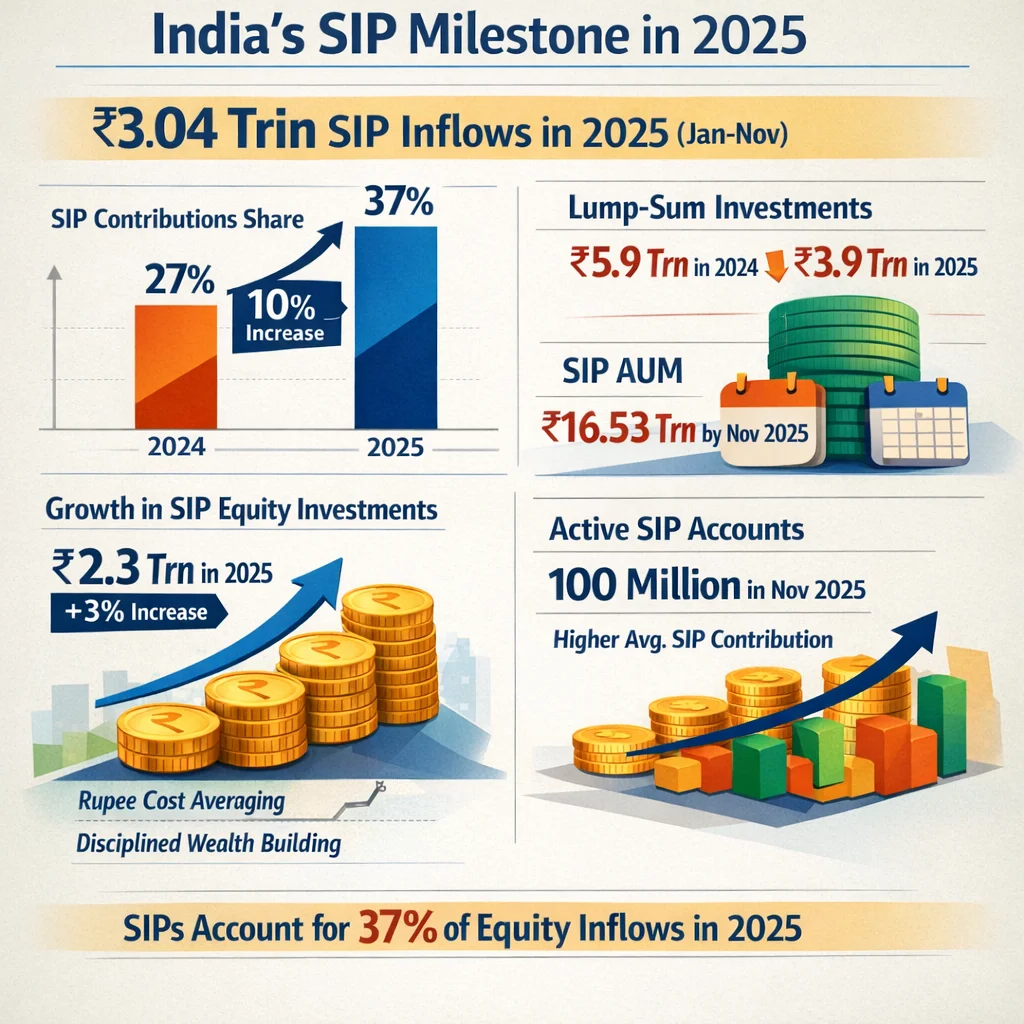
SIP Milestone Achievement: ₹3 Trillion Inflows and Industry Significance
Historic Breakthrough: ₹3.04 Trillion SIP Inflows in 2025
Mutual fund industry achieved unprecedented milestone in 2025 with systematic investment plan inflows crossing ₹3 trillion for first time in calendar year, with ₹3.04 trillion inflows through November 2025 already exceeding entire 2024 calendar year total of ₹2.69 trillion and establishing new baseline for annual SIP contribution levels. The milestone achievement—reached two months before calendar year conclusion—indicates final December 2025 figures will substantially exceed ₹3 trillion.
SIP Inflow Growth Trajectory:
|
Period |
SIP Inflows |
Year-on-Year Growth |
Cumulative Achievement |
|
FY23 (12 months) |
₹2.20 trillion |
+25% |
Baseline |
|
FY24 (12 months) |
₹2.69 trillion |
+22% |
Growth acceleration |
|
CY 2025 (11 months) |
₹3.04 trillion |
+13% |
Historic milestone |
|
CY 2025 (12 months est.) |
₹3.30+ trillion |
+23% |
Projected final |
Milestone Significance:
· Industry Maturity: SIP crossing ₹3 trillion represents institutional recognition of systematic investing importance
· Retail Investor Discipline: Demonstrates investor base development progressing from speculative to disciplined long-term approach
· Financial Inclusion: Enabling middle-class and salaried employee wealth accumulation through affordable monthly contributions
· Ecosystem Growth: Supporting mutual fund industry expansion and asset management sector development
The ₹3 trillion milestone—achieved within single calendar year—represents extraordinary growth trajectory and establishes SIPs as foundational investment vehicle for Indian retail investors.

Systematic Investment Plan (SIP): Definition and Example

Ride India's Growth Story With A Robust Equity Portfolio ...

Investment Behavior Shift: SIP Dominance vs. Lump-Sum Decline
Divergence in Investor Approach: 2024 vs. 2025 Comparison
Mutual fund industry witnessed dramatic divergence in investor behavior during 2025, with SIP investments demonstrating robust growth while lump-sum investments experienced sharp decline, establishing clear pattern where retail investors increasingly prefer systematic staggered contributions over opportunistic market-timing strategies traditionally characterizing Indian investor behavior. The behavioral shift represents fundamental change in investor psychology and confidence.
Comparative Investment Flows Analysis:
|
Investment Type |
2024 (Full Year) |
2025 (10 Months) |
Change |
% Change |
|
Lump-Sum Inflows |
₹5.9 trillion |
₹3.9 trillion |
-₹2.0 trillion |
-34% |
|
SIP Inflows |
₹2.2 trillion |
₹2.3 trillion |
+₹0.1 trillion |
+3% |
|
Total Active Equity |
₹8.1 trillion |
₹6.2 trillion |
-₹1.9 trillion |
-23% |
Divergence Interpretation:
Lump-Sum Decline Factors:
· Market volatility and uncertainty deterring large one-time investments
· Investor concerns regarding valuation levels at peaks
· Reduced availability of excess capital for opportunistic investing
· Loss of confidence in market-timing ability
· Shift toward disciplined systematic approaches
SIP Growth Despite Decline:
· Positive 3% growth in SIP investments despite lump-sum weakness
· Demonstrates investor commitment to systematic contributions regardless of market levels
· Counter-cyclical investing where market declines trigger increased contributions
· Portfolio averaging approach smoothing volatility impacts
The divergence—with SIPs expanding while lump-sum contracts—establishes clear investor preference shift toward systematic disciplines.
SIP Share Expansion: 37% vs. 27% Year-on-Year Growth
SIP investments' share in gross equity scheme inflows has expanded dramatically to 37% in first 10 months of 2025 from 27% in comparable 2024 period, representing 10 percentage point share expansion within single year and establishing SIPs as dominant equity investment vehicle surpassing lump-sum opportunistic investing. The share expansion demonstrates structural investor behavior transformation.
SIP Share Growth Implications:
Historical Context:
· 2024 SIP share: 27% (minority position relative to lump-sum)
· 2025 SIP share: 37% (approaching parity with opportunistic investing)
· Share expansion rate: 10 percentage points annually
· Trajectory toward: Potential 45-50% share by 2026-2027 if trend continues
Strategic Significance:
· SIPs transitioning from niche systematic investing to mainstream vehicle
· Institutional recognition that SIPs represent more sustainable growth engine
· Investor behavior alignment with long-term wealth accumulation objectives
· Predictable recurring flows enabling fund house operational planning
Active Equity Scheme Dominance:
· Active equity schemes capturing 80% of total SIP inflows
· Reflects investor preference for professionally managed equity exposure via systematic route
· Demonstrates confidence in active management combined with systematic discipline
· Equity-heavy SIP composition establishing aggressive wealth-building orientation
The share expansion—from minority to near-parity position—represents structural investor behavior reorientation.

Which is Better to Invest: SIP or Mutual Funds (Lumpsum ...

SIP vs Lump Sum: Choosing the Right Investment Strategy for You
Mutual Fund Industry Dynamics: Account Numbers vs. Flow Quality
Account Decline Amid Flow Growth: Data Normalization and Survivor Bias
While aggregate SIP inflows achieved record ₹3.04 trillion in 2025, the number of active SIP accounts declined from 103 million in December 2024 to 100 million in November 2025, establishing apparent paradox where lower account numbers generated higher aggregate flows, reflecting data cleanup exercises by fund houses and survivor bias where remaining accounts demonstrate superior investment discipline and commitment. The account decline—seemingly negative—actually indicates quality improvement.
Active SIP Account Analysis:
Account Count Dynamics:
· December 2024: 103 million active SIP accounts
· November 2025: 100 million active accounts
· Change: 3 million account decline (-3%)
· Underlying factor: Data cleanup exercises removing dormant and inactive accounts
Data Cleanup Context:
· Fund houses conducting systematic review of account status during market correction
· Removal of inactive accounts lacking recent contributions
· Elimination of dormant accounts generating administrative burden
· Consolidation of duplicate or redundant accounts
· Regulatory compliance and data accuracy enhancement
Quality Improvement Thesis:
Paradoxical Reality:
· Fewer accounts generating higher total inflows
· Indicates remaining accounts demonstrate higher contribution discipline
· Average SIP contribution per account increasing substantially
· Survivor accounts representing committed long-term investors
Calculation Rationale:
· FY24 average: ₹2.69 trillion ÷ 103 million accounts = ₹2,612 per account annually
· FY25 average (through Nov): ₹3.04 trillion ÷ 100 million accounts = ₹3,040 per account annually
· Average increase: ₹428 per account annually (+16.4%)
· Demonstrates increasing commitment from remaining account holders
The account decline—reflecting data normalization rather than investor attrition—actually validates SIP investment quality improvement.
SIP AUM Growth: ₹16.53 Trillion and 20% Industry Share
SIP Assets Under Management (AUM) has reached ₹16.53 trillion by November 2025, representing over 20% of mutual fund industry's total AUM of approximately ₹82-85 trillion and establishing SIPs as one of industry's most powerful growth engines and significant asset accumulation drivers. The AUM achievement demonstrates SIP materiality to industry structure.
SIP AUM Composition and Significance:
Market Share Metrics:
· Total MF Industry AUM: ₹82-85 trillion (estimated)
· SIP-contributed AUM: ₹16.53 trillion
· SIP share of total AUM: 20.0%+
· Growth rate: Expanding 3-5% annually
AUM Contribution Analysis:
· SIPs represent 1/5 of total mutual fund industry AUM
· Accumulated through systematic regular contributions rather than lump-sum windfalls
· Reflects long-term compounding benefits of consistent investing
· Demonstrating multi-year accumulation across market cycles
Comparative Growth Rates:
· SIP AUM growth: 15-20% annually
· Overall MF industry AUM growth: 8-12% annually
· SIP growth outpacing industry average by 2-3x margin
· Indicates SIPs becoming proportionately larger within industry
Strategic Importance:
· SIPs establishing most reliable, predictable revenue stream
· Recurring monthly contributions reducing lump-sum volatility dependence
· Long-term investor relationships building stronger fund house loyalty
· Investor lifetime value increasing with sustained SIP participation
The 20% AUM share—achieved through systematic contributions—establishes SIPs as industry structural foundation.

Charted: The Rise of Stock Market Volatility (2017-2025)

How To Build A Winning Mutual Fund Portfolio In India (2025 ...
Investor Psychology: Discipline, Volatility Management, and Wealth Building
Rupee-Cost Averaging: Mathematical and Psychological Benefits
SIP investment approach delivers dual benefits—mathematical rupee-cost averaging reducing cumulative investment cost during volatile periods and psychological discipline preventing emotional capitulation during market corrections—establishing systematic investing as superior wealth-building methodology aligned with long-term financial planning objectives. The benefits extend beyond simple mechanics to encompassing behavioral finance principles.
Rupee-Cost Averaging Mechanics:
Mathematical Foundation:
· Fixed monthly investment amount purchasing more units during market declines
· Purchasing fewer units during price peaks
· Average cost per unit declining relative to arithmetic mean of prices
· Long-term wealth accumulation optimized through averaging
Example Illustration:
· Investor contributes ₹10,000 monthly SIP investment
· Year-1 (market peak): ₹10,000 purchases 50 units @ ₹200/unit
· Year-2 (correction): ₹10,000 purchases 100 units @ ₹100/unit
· Year-3 (recovery): ₹10,000 purchases 75 units @ ₹133/unit
· Average cost: ₹120/unit vs. ₹144 arithmetic mean
· Advantage: ₹24 per unit cost reduction through systematic investing
Psychological Benefits:
Emotional Discipline:
· Systematic approach removes decision-making discretion during emotional periods
· Automatic investing prevents panic selling during corrections
· Eliminates requirement for market-timing ability
· Reduces regret and second-guessing regarding investment decisions
Behavioral Advantages:
· Treats investing as financial habit rather than tactical decision
· Aligns with payroll cycles and income regularity
· Creates accountability through recurring commitment
· Normalizes market volatility as investment opportunity
The combination of mathematical and psychological benefits establishes SIP superiority for wealth building.
Market Volatility Response: Increased Investments During Corrections
Remarkable investor behavior during 2025 market corrections demonstrated investor maturity: rather than withdrawing contributions during market weakness, SIP participants increased systematic investments maintaining ₹2.3 trillion contribution rate in active equity schemes despite significant market volatility and corrections, establishing counter-cyclical accumulation pattern where weakness creates buying opportunities rather than triggering panic. The behavior represents extraordinary investor sophistication maturation.
Counter-Cyclical Investing Evidence:
2025 Market Volatility Context:
· Multiple significant market corrections during first three quarters 2025
· Sharp drawdowns creating investor anxiety
· Traditional investor response: Capital withdrawal and safety-seeking
· SIP investor response: Maintained contributions despite volatility
SIP Contribution Sustainability:
· Active equity SIP inflows: ₹2.3 trillion (3% growth despite corrections)
· Monthly SIP contribution discipline unbroken through corrections
· Suggests investor confidence in long-term recovery and fundamentals
· Demonstrates understanding of volatility as temporary aberration
Investor Maturation Indicators:
· Recognition that market declines represent buying opportunities
· Understanding that systematic investing benefits from volatility
· Patience with short-term fluctuations while maintaining long-term focus
· Confidence in India's long-term economic growth trajectory
The counter-cyclical investment behavior—increasing during weakness—represents investor psychology maturation.

Matching Your Investments With Your Financial Plan | VESTED

Financial Planning | Insight Wealth Strategies | San Ramon ...
Industry Analysis: AMFI and ICRA Perspectives on SIP Growth
AMFI Characterization: "India's Preferred Long-Term Wealth-Building Habit"
Association of Mutual Funds in India (AMFI) CEO Venkat Chalasani characterized SIPs as "India's preferred long-term wealth-building habit, helping investors maintain discipline through market volatility while steadily deepening equity participation across market cycles," establishing industry leadership perspective recognizing SIPs as transformative investor behavior and institutional growth engine. The characterization reflects industry consensus regarding SIP significance.
AMFI's Strategic Assessment:
Wealth-Building Foundation:
· SIPs establishing systematic approach to wealth accumulation
· Moving investor base from speculative to disciplinary investing
· Creating generational wealth through consistent contributions
· Aligned with life-goal planning and retirement security
Volatility Management:
· SIPs enabling investors to maintain discipline during market turbulence
· Providing psychological comfort during corrections
· Demonstrating superior returns through market cycles
· Reducing regret and emotional decision-making impacts
Equity Participation Deepening:
· SIPs facilitating investor access to equity markets previously perceived as risky
· Reducing barrier to entry through affordable ₹500-1,000 monthly minimums
· Expanding equity investor base across income demographics
· Establishing sustainable equity market participation foundation
Institutional Growth Significance:
· SIPs becoming most reliable revenue stream for fund houses
· Recurring monthly contributions reducing lump-sum dependence
· Long-term investor relationships establishing loyalty
· Predictable flows enabling strategic planning
The AMFI characterization—positioning SIPs as wealth-building foundation—reflects industry's strategic focus on investor behavior improvement.
ICRA Analytics Report: ₹16.53 Trillion AUM and 20% Industry Share
ICRA Analytics report highlighted SIP AUM reaching ₹16.53 trillion by November 2025 representing over 20% of mutual fund industry's total AUM, and characterized SIPs as "one of the strongest and most reliable engines of growth for the MF industry, contributing significantly to both asset expansion and investor participation," establishing research firm validation of SIP structural importance to mutual fund sector. The report provides quantitative support for SIP significance.
ICRA Analytical Findings:
Asset Accumulation Power:
· ₹16.53 trillion AUM reflecting substantial wealth accumulation through systematic investing
· Compound annual growth rate of SIP AUM: 18-22% (exceeding industry average)
· Indicates accelerating asset accumulation as SIP investor base matures
· Suggests future SIP AUM proportional significance will exceed current 20% share
Growth Engine Assessment:
· SIPs described as "strongest and most reliable" growth engine
· Predictability of systematic flows enabling operational planning
· Recurring revenue characteristics superior to one-time lump-sum flows
· Long-term revenue sustainability aligned with mutual fund business models
Investor Participation Impact:
· SIPs significantly expanding investor base access to equity markets
· Average SIP sizes enabling middle-class participation
· Financial inclusion characteristics facilitating wealth accumulation
· Building long-term investor relationships and lifetime value
Future Trajectory Projections:
· SIP AUM anticipated to reach ₹20+ trillion within 2-3 years at current growth rates
· SIP share of total AUM potentially expanding toward 25-30% by 2027
· Indicates fundamental shift toward systematic investing dominance
· Suggests SIPs will become primary mutual fund growth driver
The ICRA analysis—providing quantitative validation—establishes research community confidence in SIP growth trajectory.

Mutual Fund Assets Market Size, Share and Forecast 2025-2034

Mutual Fund Industry FactBook – May'23 – Online Demat ...
Market Implications and Future Outlook
Investor Behavior Maturation: From Speculation to Discipline
The SIP growth phenomenon and lump-sum decline reflect fundamental investor behavior maturation away from speculative opportunistic market-timing toward disciplined systematic investing, establishing new era in Indian retail investing characterized by financial literacy improvement, goal-based planning, and volatility-tolerant long-term orientation rather than short-term trading mentality previously dominating retail investor psychology. The maturation represents generational investor consciousness shift.
Behavioral Transformation Drivers:
Financial Literacy Expansion:
· Increased awareness of compound interest and long-term wealth building
· Understanding of market volatility and risk management
· Appreciation for systematic investing mathematical advantages
· Recognition of personal timing inability relative to systematic approaches
Goal-Based Planning:
· Investor recognition that wealth building serves life objectives
· Retirement planning, children's education, and major purchases driving systematic investing
· Time-horizon alignment with investment approach
· Moving away from speculative alpha-chasing toward goal achievement
Digital Accessibility:
· Online mutual fund platforms enabling easy SIP setup
· Automatic monthly deductions from bank accounts
· Real-time portfolio tracking and transparency
· Educational content accessibility through digital channels
The behavior maturation—toward discipline from speculation—represents fundamental investor consciousness evolution.
Industry Expansion Potential: Middle-Class Financial Inclusion
The robust SIP growth trajectory—with ₹3 trillion+ annual inflows and accelerating participation—indicates substantial middle-class financial inclusion potential as salaried employees and professionals increasingly prioritize systematic wealth accumulation, establishing mutual funds as primary wealth-building vehicle for India's expanding formal sector workforce and supporting long-term economic development through consumer wealth expansion. The inclusion potential represents extraordinary development opportunity.
Financial Inclusion Characteristics:
Accessibility Enablement:
· SIP minimum amounts (₹500-1,000 monthly) enabling salary-dependent participation
· No lump-sum capital requirement barrier
· Regular income alignment with monthly SIP cycles
· Enabling lower-income formal sector workers to participate
Middle-Class Wealth Building:
· Professional and salaried employee targeting through workplace education
· Tax advantages (ELSS schemes) incentivizing SIP participation
· Goal-based product development supporting diverse financial objectives
· Financial security and retirement planning accessibility
Demographic Expansion:
· Youth (25-40 age group) representing fastest-growing SIP demographic
· Female investor participation increasing as workplace participation expands
· Rural expansion as digital accessibility improves
· Generational wealth building establishing long-term pattern
Economic Development Impact:
· Enhanced consumer demand from wealth accumulation
· Reduced household savings in unproductive assets (gold, cash)
· Capital availability to mutual funds for productive investment
· Supporting domestic economic growth and capital market depth
The financial inclusion potential—reaching 200+ million salaried workers—represents extraordinary development opportunity.
Conclusion: SIP Transformation and India's Investment Future
The SIP inflow milestone of ₹3.04 trillion in 2025—surpassing entire 2024's ₹2.69 trillion within 11 months and reaching 37% of equity scheme inflows—represents fundamental transformation in Indian retail investor behavior, establishing systematic investment plans as dominant wealth-building vehicle and displacing opportunistic lump-sum market-timing as primary investment approach. The milestone achievement transcends statistical accomplishment to represent structural investor consciousness evolution.
The simultaneous lump-sum decline to ₹3.9 trillion (from ₹5.9 trillion prior year) coupled with SIP growth (+3% despite market corrections) establishes definitive evidence that Indian retail investors increasingly recognize systematic discipline as superior to speculative timing, validating financial literacy expansion and demonstrating investor maturity shifting away from alpha-chasing toward goal-based long-term wealth accumulation aligned with retirement and life-objective planning. The behavior shift represents generational investor consciousness transformation.
The ₹16.53 trillion SIP AUM representing 20% of mutual fund industry total and growing at 18-22% annually—exceeding overall industry growth rates by 2-3x—establishes SIPs as mutual fund sector's most powerful growth engine and indicates proportional significance will continue expanding toward 25-30% of total AUM within 2-3 years, fundamentally reshaping industry structure and establishing SIPs as foundational wealth-building mechanism for India's expanding middle class. The structural significance will only increase going forward.
For Indian investors, the SIP phenomenon validates long-term wealth-building through systematic discipline, demonstrates mathematical and psychological advantages of rupee-cost averaging, and establishes mutual funds through SIPs as optimal vehicle for retirement planning, goal-based accumulation, and financial security amid market volatility and economic uncertainty. The investment approach aligns with behavioral finance principles and long-term financial security.
Looking forward, SIP growth trajectory—with current momentum and expanding digital accessibility—indicates India's mutual fund sector will achieve unprecedented scale through systematic investing, enabling middle-class financial inclusion across 200+ million salaried employees and establishing mutual funds as primary wealth-building vehicle supporting long-term economic development and consumer wealth expansion. The opportunity represents extraordinary development potential.**
Citations:
Business Standard - SIP inflows cross ₹3 trillion in 2025 as investors shun lump-sum bets (December 26, 2025); Association of Mutual Funds in India (AMFI) - SIP inflow data December 2025, ₹3.04 trillion through November 2025 vs. ₹2.69 trillion full-year 2024; ICRA Analytics - SIP AUM report, ₹16.53 trillion November 2025, 20% of total industry AUM; Active equity scheme data - Lump-sum inflows ₹3.9 trillion (October 2025) vs. ₹5.9 trillion (2024); SIP equity scheme inflows ₹2.3 trillion (3% growth); SIP share analysis - 37% of gross equity inflows (2025) vs. 27% (2024); Active SIP account data - 100 million accounts November 2025 vs. 103 million December 2024; Venkat Chalasani, AMFI CEO - Statement on SIPs as India's preferred wealth-building habit; Financial literacy and investor behavior analysis - Market timing limitations and discipline advantages; Rupee-cost averaging analysis - Mathematical and psychological benefits; Counter-cyclical investing evidence - SIP continuity during market corrections; Digital accessibility impact - Online platforms and automatic investment mechanisms; Middle-class financial inclusion potential - Salaried employee base and systematic wealth building; Retirement planning and goal-based investing framework; Equity market participation expansion through systematic investing accessibility

Post your opinion
No comments yet.