Polar Vortex Evolution During Sudden Stratospheric Warmings: Energetic Electron Precipitation Effects on Atmospheric Dynamics

Recent research from the Earth and Space Science Open Archive reveals that the stratospheric polar vortex responds distinctly to energetic electron precipitation (EEP) only during winters when sudden stratospheric warmings (SSWs) occur, demonstrating a critical coupling between solar-driven particle precipitation and large-scale atmospheric circulation patterns. The study, utilizing comprehensive reanalysis data spanning 1957-2017 and geomagnetic activity proxies for EEP, shows that EEP-induced enhancement of the polar vortex and associated dynamical responses are contingent upon the presence of substantial planetary wave activity that precedes and accompanies SSWs. This research fundamentally advances understanding of how space-weather phenomena interact with planetary-scale atmospheric dynamics to modulate the polar vortex—a critical component of the climate system that influences weather patterns across the Northern Hemisphere. The findings highlight that atmospheric conditions preceding SSWs favor enhanced wave-mean-flow interaction that can dynamically amplify the initial polar vortex enhancement caused by ozone loss from EEP.[1][2][3][4]
The Polar Vortex: Foundational Concepts in Atmospheric Dynamics
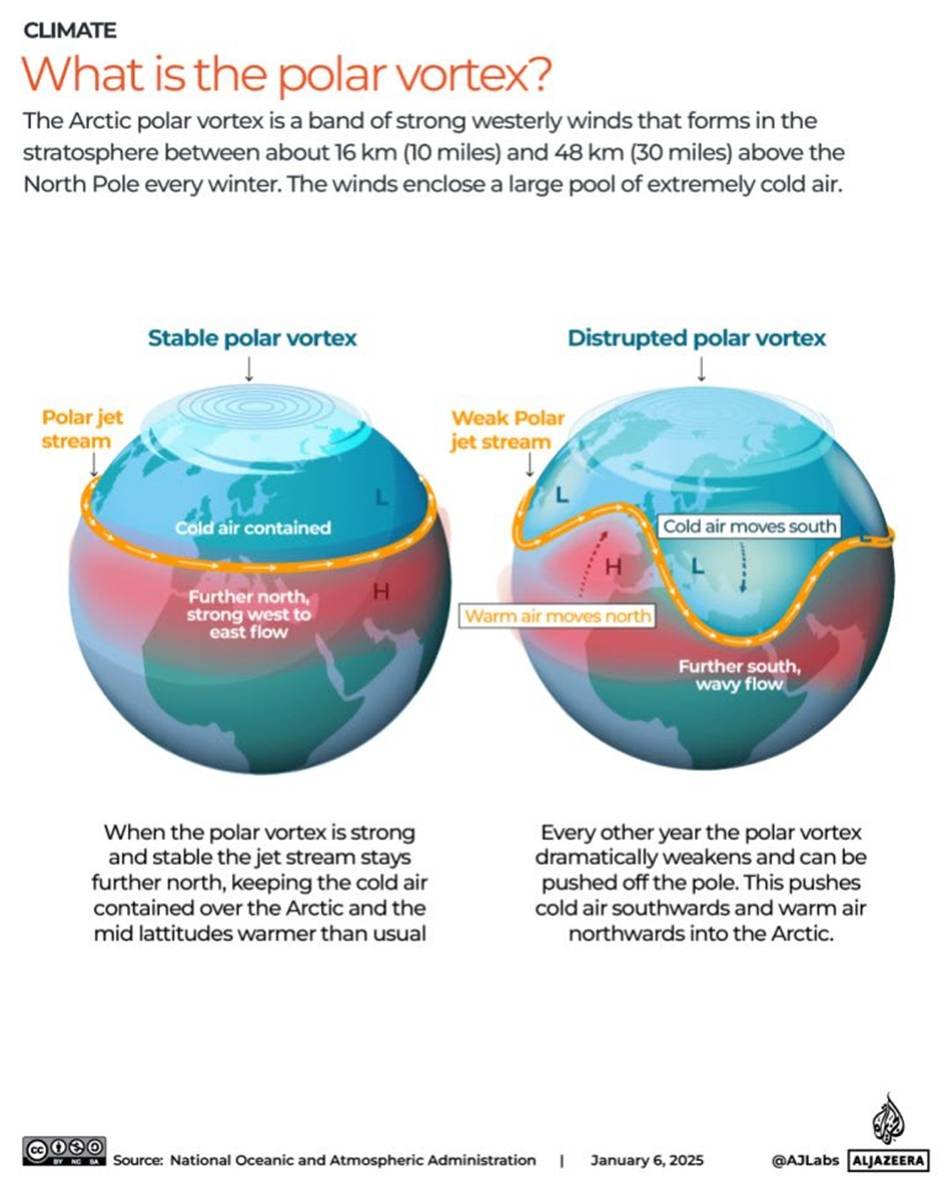
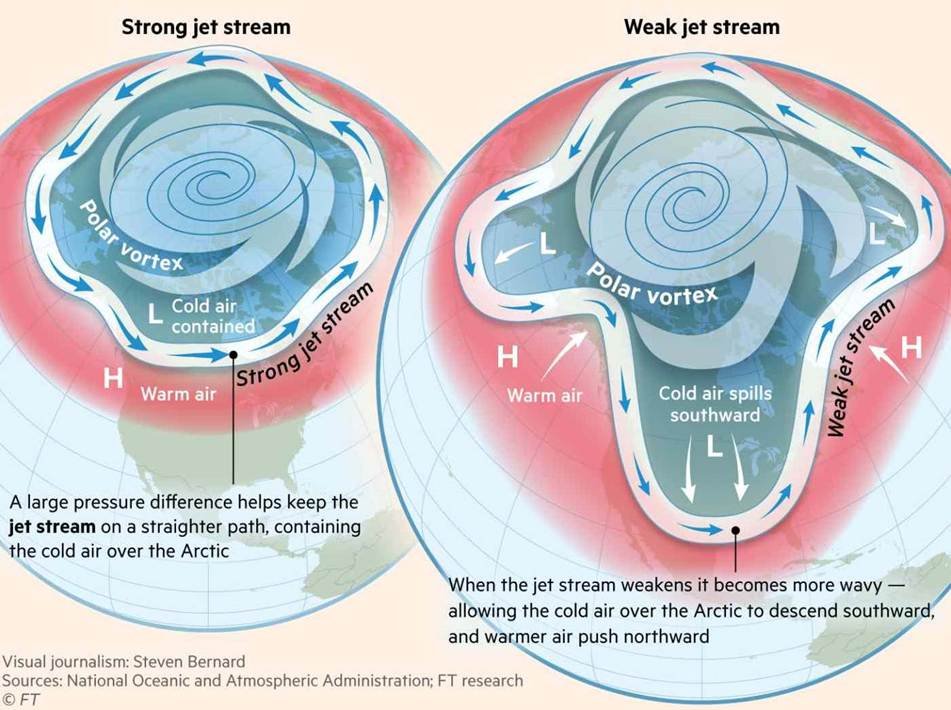
The stratospheric polar vortex represents one of Earth's most dramatic atmospheric features—a massive rotating column of cold, dense air circling the Arctic region during winter months. This circulation system is characterized by extremely strong westerly winds that can exceed 300 km/hour at its core, creating a dynamical barrier that isolates polar air from mid-latitude air masses.[5]
What is a polar vortex, the weather event causing winter ...
Physical Characteristics and Formation
The polar vortex forms during autumn when differential solar heating creates a strong temperature gradient between the warm mid-latitudes and the cold, perpetually dark polar region. This temperature gradient generates a pressure difference that drives powerful westerly winds in the stratosphere (the atmospheric layer 10-50 km above Earth's surface). These winds increase in strength through fall and early winter, reaching maximum intensity by December-January.[5]
The vortex serves as a critical dynamical structure because:
· It confines cold air: The strong westerly winds create a circulation barrier preventing cold Arctic air from moving equatorward
· It controls atmospheric composition: The isolated vortex air experiences unique chemical processes, including polar stratospheric ozone depletion
· It affects weather patterns: When the vortex weakens or breaks down, tropospheric weather patterns respond dramatically
The polar vortex exhibits a regular seasonal cycle:[5]
· Autumn (September-October): Vortex formation begins as polar cooling accelerates
· Winter (December-February): Vortex reaches maximum strength with intense westerly winds
· Spring (March-April): Vortex weakens as seasonal solar heating begins
· Summer (May-September): Easterly summer circulation replaces the westerly vortex
This seasonal evolution reflects fundamental changes in solar heating patterns and atmospheric stability that drive planetary-scale circulation changes.
Sudden Stratospheric Warmings: Extreme Disruptions of the Polar Vortex
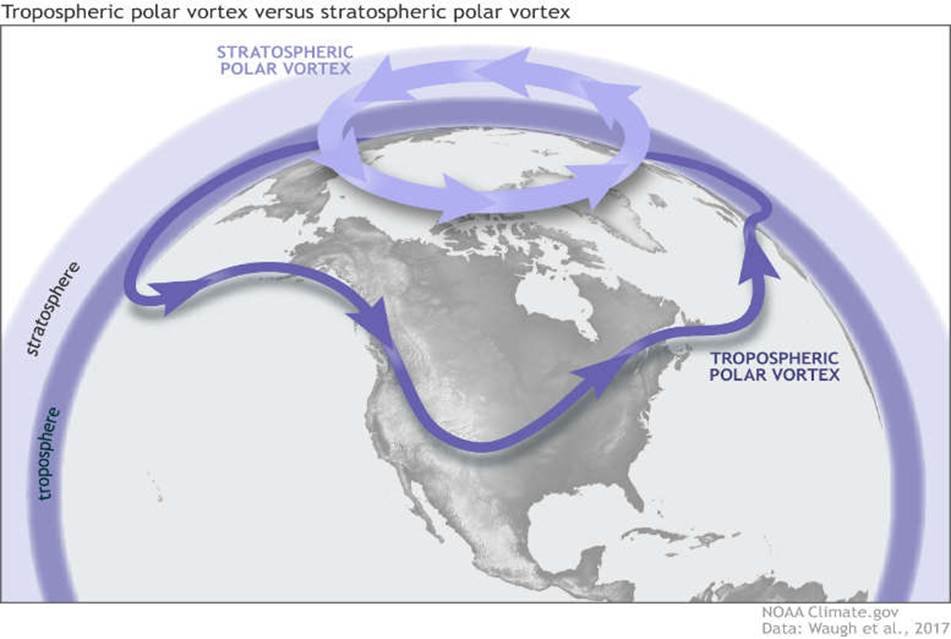
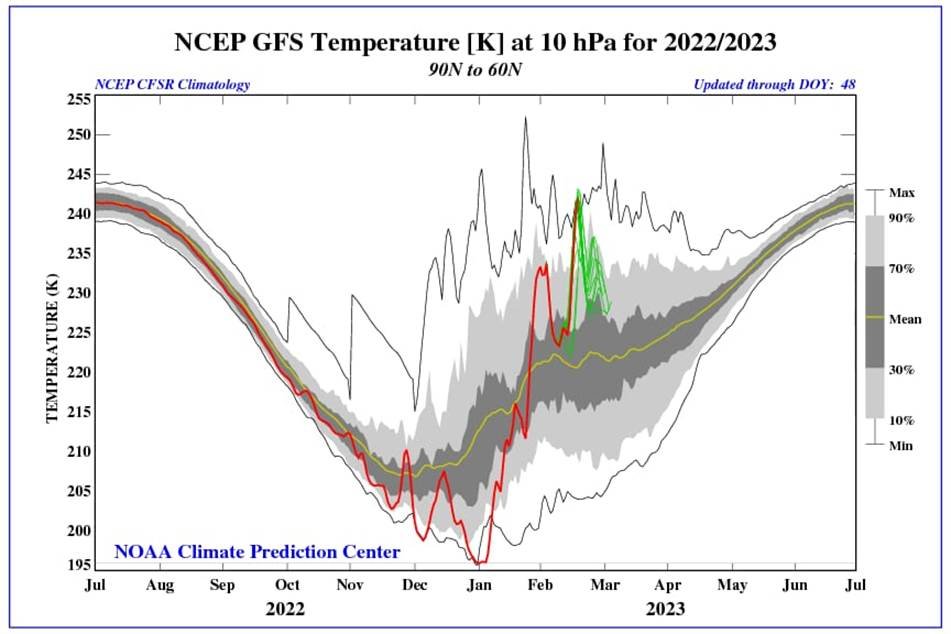
Sudden Stratospheric Warmings (SSWs) represent extraordinary disruptions of the polar vortex characterized by rapid temperature increases of 40-60 K in the polar stratosphere and a complete reversal of the climatological westerly winds. These extreme events transform the entire character of the stratospheric circulation within a period of just a few days to weeks.[5]
Sudden Stratospheric Warming: How SSW Disrupts Weather
SSW Characteristics and Classification
SSWs occur approximately 6 times per decade and manifest in two primary configurations:[5]
Vortex Displacement Events:
· The polar vortex shifts off the pole, typically toward the Atlantic/Europe sector
· Vortex circulation remains relatively intact but displaced geographically
· Associated with dominant wavenumber-1 planetary wave activity
· Wind reversal begins at polar latitudes and expands poleward
Vortex Split Events:
· The polar vortex breaks into two separate circulation cells
· Each mini-vortex circulates in opposite directions
· Associated with dominant wavenumber-2 planetary wave activity
· More complex wind reversal patterns across the polar region
Physical Mechanisms Driving SSWs
SSWs originate in the troposphere through enhanced planetary wave forcing that propagates upward into the stratosphere. The mechanism involves:[5][6]
1. Rossby wave amplification: Large-scale atmospheric waves in the troposphere grow in amplitude
2. Upward wave propagation: These amplified waves penetrate into the stratosphere where density is lower and amplitudes grow further
3. Wave breaking: The amplified waves "break" similar to ocean waves, transferring their momentum to the background flow
4. Vortex disruption: The momentum transfer decelerates and reverses the polar vortex westerly winds
The specific tropospheric patterns that favor SSW development typically involve persistent high-pressure systems over certain regions (like the North Pacific/North Atlantic) that generate large planetary-scale wave patterns. These patterns can persist for weeks, allowing wave amplitude to build gradually before the eventual vortex disruption.[6]
SSWs can eventually influence tropospheric weather through stratosphere-troposphere coupling, potentially causing:[5]
· Cold air outbreaks: Over North America, Europe, and Asia as displaced polar air moves equatorward
· Regional warming: Over Greenland and eastern Canada in some SSW events
· Jet stream disruption: Equatorward shift of the winter jet streams allowing polar air intrusions
· Precipitation anomalies: Changes in atmospheric moisture transport and storm track patterns
However, the surface response is not deterministic—some SSWs produce dramatic surface impacts while others show minimal tropospheric coupling, depending on complex interactions with other climate modes.
Energetic Electron Precipitation: Space-Weather Influence on the Atmosphere
Energetic Electron Precipitation (EEP) represents a direct coupling mechanism between solar wind-driven space weather and Earth's middle atmosphere, providing a pathway for solar influence on planetary climate and weather systems.[2][3][7]
EEP Sources and Physical Mechanisms
EEP originates from the Earth's magnetosphere—the region of space dominated by Earth's magnetic field surrounding the planet. When solar wind particles and electromagnetic disturbances interact with the magnetosphere, they can trigger energetic particle precipitation events where high-energy electrons cascade down into the polar atmosphere.[2]
In the atmosphere, precipitating energetic electrons create chemical effects:[7][8]
· Direct ionization: High-energy electrons collide with atmospheric molecules, creating ion pairs
· NOX production: These ionization events generate odd-nitrogen species (NOX = NO + NO₂) that catalyze ozone destruction
· Ozone depletion: NOX-driven ozone loss in the mesosphere and upper stratosphere reduces ozone concentrations by 10-50% in some cases
· Temperature changes: Ozone loss reduces solar heating in the upper atmosphere, causing cooling; simultaneously, absorption of downwelling infrared radiation causes warming in regions where ozone remains
EEP-Induced Dynamical Responses
The chemical effects of EEP-induced ozone loss generate dynamical responses through a complex cascade of mechanisms:[8]
1. Temperature perturbations: Ozone loss alters the temperature structure, modifying atmospheric stability
2. Wind response: Temperature changes drive pressure adjustments that affect the zonal wind field
3. Circulation modification: Wind changes alter planetary-wave propagation and wave-mean-flow interactions
4. Vortex strengthening: In favorable conditions, the cumulative effect strengthens the polar vortex westerly winds
Previous research established that increased EEP correlates with polar vortex strengthening in winter, a relationship that depends on the quasi-biennial oscillation (QBO)—a 28-month oscillation of equatorial wind patterns. However, the physical mechanism linking EEP to vortex strengthening remains complex and incompletely understood.[2][7][8]
The Novel Finding: EEP Effects Contingent on SSW Occurrence
The critical new finding from this research is that EEP-related enhancement of the polar vortex appears predominantly (or exclusively) during winters when SSWs occur, representing a fundamental insight into how different atmospheric forcing mechanisms interact.[1][2][3]
Sudden Stratospheric Warming Events
Study Methodology and Data Sources
The research employed rigorous observational analysis combining:[2][3]
· Reanalysis data: ERA-40 (1957-1979) and ERA-Interim (1979-2017) comprehensive atmospheric datasets
· Geomagnetic indices: Proxies for energetic electron precipitation activity based on geomagnetic disturbance measurements
· SSW identification: Standard meteorological criteria identifying the ~60 major SSW events in the 60-year period
· Statistical analysis: Composite and regression analyses separating EEP effects during SSW and non-SSW winters
· Total study period: 1957-2017 (60 years of continuous data)
· SSW occurrence: ~6 events per decade, with 60 major SSWs identified in the study period
· Geomagnetic activity: Continuous monitoring providing EEP proxy data for all years
The analysis revealed several striking results:[1][2][3]
1. EEP effects limited to SSW winters: The polar vortex enhancement from EEP is systematically observed only during winters experiencing SSWs, not during "quiet" winters without SSWs
2. Pre-SSW timing: EEP-induced vortex changes occur slightly before SSW onset, suggesting EEP may contribute to pre-conditioning rather than post-event modification
3. Wave-mean-flow amplification: Atmospheric conditions preceding SSWs favor enhanced wave-mean-flow interaction that amplifies the initial vortex enhancement from ozone loss
4. Dynamical coupling: The results demonstrate that planetary wave activity is essential for manifesting EEP effects, indicating that wave-driven dynamics fundamentally modulate how space weather influences the polar vortex
Interpretation: Why SSWs Matter for EEP Effects
The finding that EEP effects require SSW conditions suggests a crucial interaction mechanism:[2][3][4]
During non-SSW winters:
· The polar vortex is strong and stable with minimal planetary wave activity
· This stable configuration limits the effectiveness of small perturbations from EEP
· Ozone loss and temperature changes from EEP remain small and insufficient to significantly affect a strong circulation system
· The robust vortex structure acts as a "barrier" limiting EEP dynamical influence
During SSW-precursor conditions:
· Enhanced planetary wave activity creates atmospheric instability
· The vortex becomes sensitive to small perturbations
· EEP-induced temperature and ozone changes coincide with conditions favoring wave-mean-flow interactions
· These perturbations trigger (or amplify) the cascade toward vortex breakdown
· The dynamical amplification effect greatly magnifies the initial EEP signal
This interpretation suggests that EEP doesn't independently cause strong vortex changes; rather, it provides an additional small perturbation that becomes amplified during dynamically favorable conditions featuring enhanced planetary wave activity.[3][4]
Atmospheric Wave-Mean-Flow Interactions: The Amplification Mechanism
Understanding how small EEP perturbations become amplified requires examining wave-mean-flow interactions—the fundamental mechanism through which atmospheric waves exchange momentum with the mean circulation.[4][9]
3.4.7: Extratropical Ridges and Troughs (Rossby Waves ...
Planetary Wave Propagation and Breaking
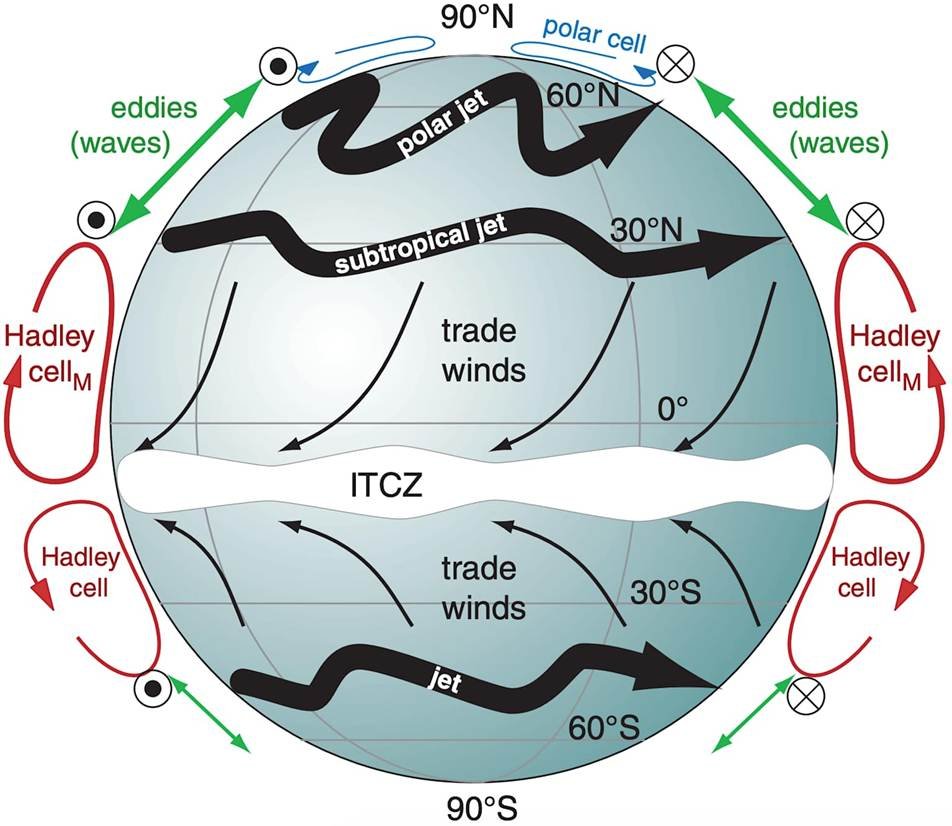
Planetary waves (Rossby waves) propagate vertically from the troposphere into the stratosphere, with their propagation controlled by the background wind field:[10][5]
· In strong westerly flow: Waves can propagate upward efficiently, reaching high stratospheric altitudes before breaking
· In weak or reverse (easterly) flow: Waves encounter refractive barriers preventing upward propagation
· At critical levels: Where wave phase speed matches wind speed, waves preferentially break and dissipate their momentum
The Eliassen-Palm (EP) flux—a diagnostic tool measuring wave activity and momentum transfer—reveals:[4][9]
· EP flux divergence: Regions where waves dissipate and transfer momentum to the background flow
· Wave amplitude growth: Vertical increasing in wave amplitude as density decreases with altitude
· Momentum transfer: Positive (westerly) or negative (easterly) momentum transfer depending on wave geometry
Pre-SSW Wave-Mean-Flow Conditions
Prior to SSWs, the atmosphere exhibits distinctive wave characteristics that create conditions favorable for amplification:[4][9]
· Enhanced planetary wave amplitudes: Tropospheric wave source regions generate stronger-than-normal wave activity
· Favorable vertical propagation: Wind field conditions allow efficient upward wave propagation
· Increased wave-mean-flow interaction: Large amplitude waves transfer substantial momentum, significantly modifying the wind field
· Positive feedback: Weakening of the vortex reduces the barrier to wave propagation, allowing even more wave energy to reach the stratosphere
This positive feedback creates an "instability" where small perturbations can trigger runaway amplification leading to vortex breakdown.
EEP as a Triggering Perturbation
In this framework, EEP provides a small initial perturbation (ozone loss, temperature change, wind modification) that:[2][3]
· Modifies wave propagation conditions: Temperature and wind changes from EEP alter the refractive index for wave propagation
· Enhances wave-mean-flow interaction: By adjusting the background wind field slightly, EEP can increase the efficiency of momentum transfer
· Triggers dynamical amplification: The enhanced wave interaction provides a small push that triggers (or accelerates) the vortex disruption process
The perturbation itself is small—typically 5-10% changes in ozone or temperature—but in the presence of strong planetary wave activity, this small perturbation can trigger or amplify the cascade toward vortex breakdown.[4][2]
Climate and Weather Implications
Understanding the interaction between EEP and SSW dynamics has important implications for climate science and weather prediction:[2][7][11]
Things are Getting Heated: The Science behind the Polar ...
Stratosphere-Troposphere Coupling and Weather Impacts
When SSWs occur, they can eventually couple to the troposphere, affecting surface weather patterns that impact human populations:[11][5]
· Cold air outbreaks: Displacement of the polar vortex allows cold Arctic air to invade middle latitudes, causing extreme cold events
· Surface pressure patterns: SSWs induce changes in mid-latitude jet streams and high-latitude blocking patterns
· Regional precipitation changes: Altered atmospheric circulation affects moisture transport and storm development
· Potential predictability: The 2-3 week timescale from SSW onset to surface impacts provides a potential "predictability window" for seasonal weather forecasting
Solar Influence on Weather and Climate
The EEP-SSW interaction provides one mechanism through which solar activity might influence Earth's weather and climate:[7][12]
· Solar modulation of particle precipitation: Variations in solar wind and magnetospheric conditions affect EEP magnitude
· QBO modulation: The quasi-biennial oscillation (which itself may have solar-driven components) modulates how effectively EEP influences the stratosphere
· Long-term variability: Multi-year to decadal variations in EEP magnitude could contribute to stratospheric variability with tropospheric impacts
However, the EEP effect is modest compared to major forcing mechanisms like volcanic aerosols, ozone depletion, and greenhouse gas increases. Its significance likely lies in providing an additional small component of variability that could modulate the sensitivity of the polar vortex to other forcing mechanisms.
Implications for Atmospheric Predictability
Understanding when EEP effects manifest provides insights into atmospheric predictability:[6][13]
· Preconditioned conditions: The requirement for SSW-favorable conditions identifies specific atmospheric configurations where perturbations have outsized effects
· Sensitivity to initial conditions: Atmospheres with enhanced planetary wave activity show greater sensitivity to small perturbations
· Ensemble forecasting: Recognizing which conditions favor amplification helps probabilistic forecast systems assess confidence in predictions
Several important questions remain for future investigation:[2][3][4]
Outstanding Scientific Questions
· Causality vs. correlation: Does EEP causally contribute to SSW development, or does wave activity that precedes SSWs coincidentally enhance EEP effects?
· Mechanism specificity: What exact aspects of the wave-mean-flow interaction are modified by EEP to trigger amplification?
· Other forcing mechanisms: How do other stratospheric perturbations (volcanic aerosols, changes in ozone abundance, greenhouse gas forcing) interact with planetary waves and SSWs?
· Southern Hemisphere dynamics: Are similar EEP-SSW relationships present in the Southern Hemisphere where the vortex dynamics differ?
Modeling and Observational Needs
Advancing understanding requires:[7][12]
· High-resolution chemistry-climate models: Simulations explicitly representing ozone chemistry, wave dynamics, and EEP effects simultaneously
· Satellite observations: Direct measurements of NO_X, ozone, and temperature with high spatial/temporal resolution during EEP events
· Long observational records: Extending analysis periods to capture rare EEP events coinciding with SSWs
· Machine learning approaches: Pattern recognition methods to identify precursor conditions and amplification mechanisms
Conclusion: Integrating Space Weather and Atmospheric Dynamics
This research reveals that understanding polar vortex evolution requires integrating multiple scientific domains—solar-driven space weather, upper atmospheric chemistry, and planetary-scale atmospheric dynamics. The finding that energetic electron precipitation influences the polar vortex only during sudden stratospheric warming events demonstrates how complex Earth systems operate through nonlinear interactions where the effectiveness of perturbations depends critically on the background atmospheric state.[1][2][3]
The polar vortex, far from being a simple isolated system, exhibits surprising sensitivity to space-weather perturbations—but only when large-scale atmospheric wave patterns create favorable dynamical conditions. This illustrates a fundamental principle in geophysics: different forcing mechanisms interact non-additively, with the response to one perturbation depending on the presence and magnitude of other perturbations.[2][4]
As understanding improves, the capability to predict SSWs and their surface impacts will likely increase, potentially extending forecast skill for mid-latitude winter weather 2-3 weeks in advance. Simultaneously, recognizing solar influences on stratospheric dynamics contributes to the broader scientific understanding of how Earth's climate system responds to both internal variability and external solar forcing across multiple coupled atmospheric layers.

Post your opinion
No comments yet.